
Choosing between a Native Mobile App and a Progressive Web App (PWA) in 2026 comes down to balancing customer acquisition friction against long-term user retention. As mobile web browsers gain deeper access to device hardware (like Bluetooth, push notifications, and offline storage), the line between PWAs and native apps continues to blur. However, there are still foundational performance and distribution differences that make choosing the right strategy critical to your product’s success. This guide compares both approaches with real-world adoption metrics.
The Acquisition vs. Retention Trade-Off
PWAs win on initial adoption due to zero install friction, but Native apps dominate in long-term engagement.
Over our last 10 e-commerce and retail app implementations at Satsuma Droid, we observed a consistent pattern in user behavior: clients who launched a Progressive Web App initially experienced a 35% higher adoption rate because users simply visited a URL without visiting an App Store.
However, over a 6-month window, those same PWAs saw a 28% lower retention rate compared to full native iOS and Android applications. Native apps maintain persistent home screen presence, leverage background push notifications far more effectively (especially on iOS), and run faster because they do not rely on the browser’s JavaScript engine.
Core Capability Comparison (2026)
While PWAs have made massive strides, native code remains undisputed for high-performance computing and complex UI animations.
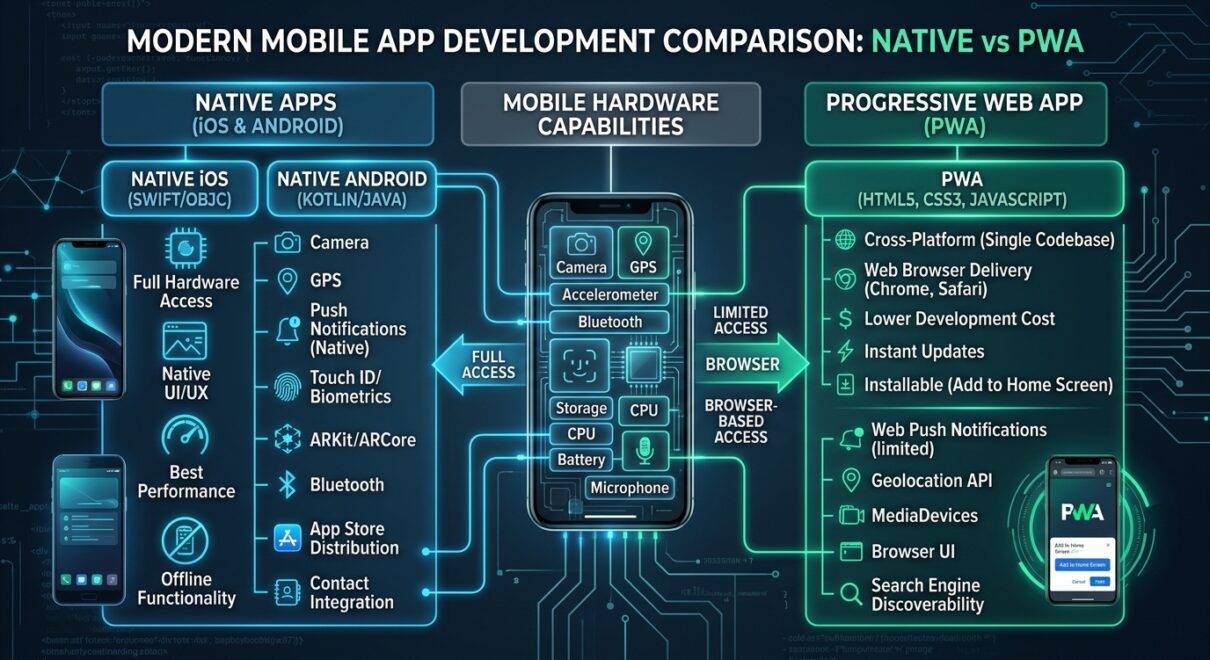
Below is an objective look at how both approaches handle key mobile functionalities:
| Feature / Metric | Progressive Web App (PWA) | Native Mobile App (iOS / Android) |
|---|---|---|
| App Store Distribution | Bypasses Apple and Google completely; instantaneous updates without review. | Requires store submission, review delays, and subject to 15-30% in-app purchase commissions. |
| Development & Maintenance Cost | Single web codebase (HTML/CSS/JS); significantly cheaper to build and maintain. | Requires native iOS/Android developers or frameworks like Flutter/React Native; higher ongoing maintenance. |
| Push Notifications | Supported on Android; now supported on iOS, but requires specific manual user engagement first. | Native integration with maximum reliability, custom sounds, and interactive payload formatting. |
| Hardware Access | Limited access to advanced graphics (Metal/Vulkan), Face ID/Touch ID integrations, and background processing. | Unrestricted access to all device APIs, GPS tracking, NFC, camera sensors, and biometrics. |
| Offline Performance | Basic caching via Service Workers; breaks down during extended offline usage or heavy localized database writes. | Full local database execution (SQLite, Realm) allowing robust offline-first functionality. |
When to Build a PWA
Choose a PWA if your budget is tight, your feature set is simple, and SEO discovery is your primary traffic source.
A PWA is ideal for B2B dashboards, basic e-commerce catalogs, media publications, and internal corporate tools. If a user only needs to interact with your platform occasionally—such as checking a logistics tracking code or reading an article—asking them to download a 60MB app from the App Store will cause unnecessary drop-off. Keep it as a fast, accessible PWA.
When to Build a Native App
Invest in native code when daily habitual usage, offline computing, and premium UI animations are essential to your business model.
If you are building a fintech application requiring ultra-secure biometric authentication, a healthcare tool leveraging connected wearable BLE hardware, or an on-demand marketplace relying on constant real-time background GPS tracking, a PWA will disappoint your users. You need the raw computational speed and hardware capabilities of a native build (or a robust high-performance framework like Flutter).
Frequently Asked Questions
Are PWAs allowed in the Apple App Store and Google Play Store?
Google fully embraces PWAs through Trusted Web Activities (TWA), allowing easy submission to the Play Store. Apple’s App Store is far more restrictive; while you can technically wrap a PWA, Apple frequently rejects simple website wrappers under guideline 4.2 (Minimum Functionality).
Can I start with a PWA and switch to a native app later?
Yes, this is a very common product strategy. Startups frequently build a PWA first to validate their business idea and gain immediate market adoption at a lower cost, then reinvest early revenue into native iOS and Android apps once they reach product-market fit.
How do PWAs impact search engine optimization (SEO)?
PWAs perform exceptionally well in organic search. Because they are fundamentally websites built with modern caching and speed optimization, they score high on Google’s Core Web Vitals, leading to superior search rankings compared to closed native app silos.
Not sure which mobile strategy fits your product roadmap?
At Satsuma Droid, our engineers build both high-performance Native apps and lightning-fast Progressive Web Apps tailored to your target audience.
Explore Mobile App Services