
The short answer: in 2026, B2B SaaS marketing succeeds on bottom-funnel search intent and account-based channels
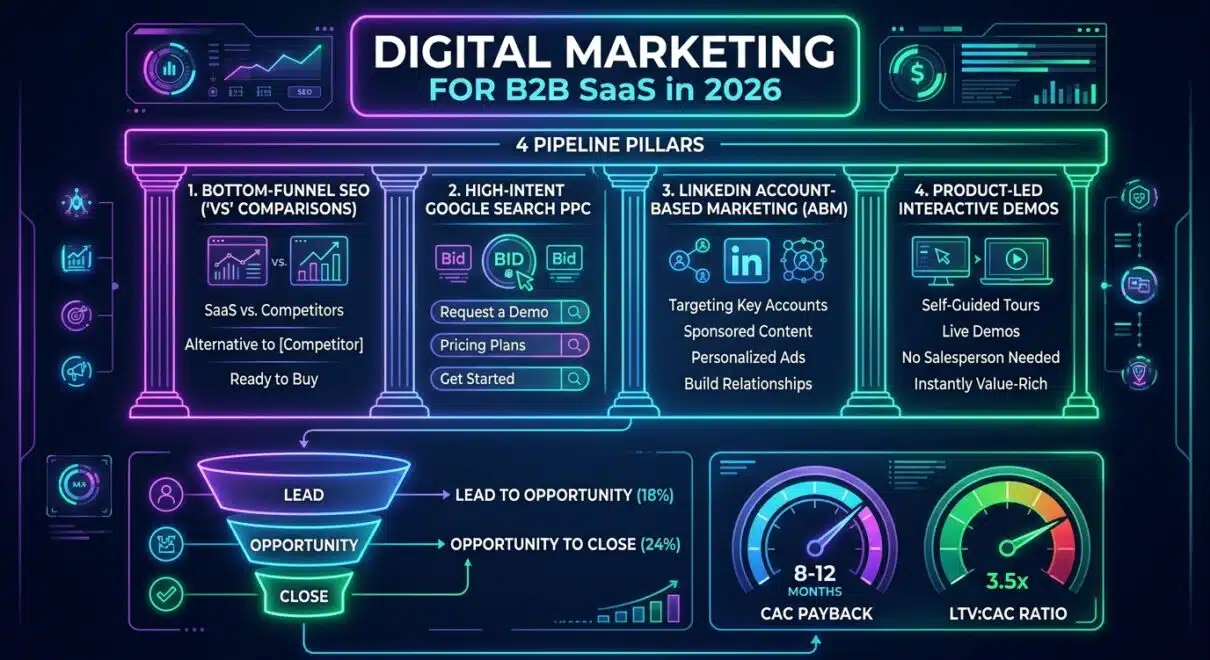
Digital marketing for B2B SaaS in 2026 generates measurable sales pipeline through four core channels: bottom-funnel SEO (commercial “Alternative to [Competitor]” and “Best software for [Use Case]” pages), high-intent Google Search PPC targeting active buyers, targeted account-based marketing (ABM) on LinkedIn, and product-led technical documentation. Conversely, top-of-funnel generic ebooks, broad Facebook/Instagram display retargeting, and vanity brand impressions waste up to 60% of early-stage marketing budgets. Sustainable SaaS marketing aims for a customer acquisition cost (CAC) payback period of under 12 months with a Lead-to-Opportunity conversion rate above 15%.
Too many software companies treat SaaS marketing like consumer e-commerce, pouring funds into broad awareness campaigns and measuring success by website visits rather than Sales Qualified Leads (SQLs) and annual recurring revenue (ARR). In enterprise and B2B software, buyers conduct extensive independent research before requesting a demo. Below is a strategic breakdown of the marketing channels that drive actual pipeline, the metrics that matter, and the costly marketing traps to eliminate.
Channel evaluation matrix: What drives revenue vs. what burns capital
To allocate your marketing budget effectively, evaluate each channel by its conversion velocity, lead intent, and average payback period:
| Marketing Channel | Lead Intent Level | Average CAC Payback | Pipeline Impact Assessment |
|---|---|---|---|
| Bottom-Funnel SEO (“vs”, “alternative”, “pricing”) | High (Active buyer evaluation) | 4 to 8 months | Highest long-term ROI. Captures prospects who are already committed to buying software in your category. |
| Google Search PPC (Exact match commercial intent) | High (Immediate problem solving) | 6 to 11 months | Immediate pipeline generation when strictly restricted to phrase and exact match keywords with negative list filtering. |
| LinkedIn ABM & Content (Job title & industry targeting) | Medium to High (Decision-makers) | 9 to 14 months | Essential for mid-market and enterprise deals ($15k+ ACV). High CPL ($80–$180), but delivers verified corporate stakeholders. |
| Product-Led Content & Docs (Interactive tutorials & API guides) | High (Technical evaluators) | 5 to 9 months | Drives bottom-up adoption by developers and operational users who champion the tool to executive leadership. |
| Broad Social Display Ads (Meta / Instagram / Display Networks) | Low (Passive interruption) | 20+ months (Often negative) | Ineffective for complex B2B software. High click volumes with near-zero Demo-to-Close conversion rates. |
The 4 digital marketing pillars that produce verified SaaS pipeline
1. Bottom-funnel “Job-to-be-Done” organic search
Do not waste early marketing capital writing generic educational posts like “What is CRM?” or “Benefits of Cloud Software.” Large legacy publishers dominate those definitions. Instead, build high-intent comparison assets:
- Direct Competitor Comparisons: “[Your Product] vs [Market Leader]: 2026 Feature and Pricing Breakdown.”
- Alternative Hubs: “Top 5 Alternatives to [Incumbent Software] for Mid-Sized Teams.”
- Use-Case Landing Pages: “Inventory Management Software for Halal Meat Exporters” or “Dispatch Software for Private Transport Fleets.”
Prospects searching these queries have active budgets and purchasing authority. In our client campaigns, bottom-funnel comparison pages convert to demo requests at 8% to 14%, compared to under 0.8% for general top-of-funnel blog posts.
2. Laser-targeted Google Search ads with strict negative lists
PPC fails for SaaS when campaigns rely on broad match keywords that attract job seekers, students, and people looking for free open-source templates. Successful SaaS PPC requires:
- Targeting high-intent phrase and exact match keywords (e.g.
"logistics dispatch software pricing","custom billing platform for SaaS"). - Maintaining an exhaustive negative keyword list (excluding terms like “free”, “jobs”, “internship”, “salary”, “github”, “open source”).
- Directing paid traffic to dedicated, distraction-free landing pages with interactive product tours or frictionless 3-field demo forms.
3. LinkedIn account-based marketing (ABM) for high ACV deals
If your average contract value (ACV) exceeds $10,000 annually, LinkedIn is the primary paid channel that allows targeting by specific company names, employee count, and seniority (e.g., “VP of Logistics”, “Head of Engineering”, “Chief Technology Officer”). Rather than pitching immediate demos, run concise video case studies and carousel breakdowns demonstrating how you solved a specific operational bottleneck for a peer enterprise.
4. Product-led onboarding & interactive demo tours
Modern software buyers resist scheduling a 30-minute sales call merely to see the user interface. Embedding interactive product walkthroughs (using tools like Navattic or interactive sandbox environments) directly on your website allows buyers to experience value within 90 seconds. Prospects who complete a self-guided product tour convert into qualified pipeline at nearly double the rate of static form submissions.
3 marketing traps that waste SaaS budgets
1. Gated generic whitepapers and ebooks: Forcing visitors to provide their corporate email and phone number to read a 10-page generic PDF generates hundreds of low-intent “leads” who ignore sales outreach. Gated content inflates marketing MQL metrics while contributing zero dollars to closed-won revenue.
2. Focusing on MQLs instead of pipeline opportunities: Marketing agencies often report success based on Marketing Qualified Leads (downloads, webinar signups). True SaaS performance must be evaluated on Sales Qualified Opportunities (SQOs), pipeline value created, and customer acquisition payback time.
3. Scaling ad spend before fixing demo conversion friction: If your landing page converts less than 2% of visitors into demo requests, doubling your ad spend merely doubles your wasted capital. Refine your value proposition, page load speed, and social proof before increasing ad spend.
Key SaaS digital marketing performance benchmarks for 2026
Track your growth against these operational benchmarks:
- Visitor-to-Lead Conversion Rate: 2.5% to 5.0% on high-intent commercial landing pages.
- Lead-to-Opportunity (Demo) Rate: 15% to 25% of submitted leads booking and attending a live call.
- Opportunity-to-Close Rate: 20% to 30% of sales opportunities converting to paying accounts.
- Blended CAC Payback Period: 8 to 14 months for B2B SME software; 12 to 18 months for enterprise contracts.
- LTV:CAC Ratio: 3:1 or higher for sustainable unit economics.
FAQ: Digital marketing for B2B SaaS companies in 2026
How much should a B2B SaaS startup spend on digital marketing?
Early-stage SaaS startups typically allocate 25% to 40% of target annual recurring revenue to marketing and sales. In dollar terms, an early-stage B2B SaaS company usually begins with $3,000 to $8,000 per month across search advertising, targeted content, and SEO.
Which is better for B2B SaaS: SEO or Google Ads?
Both are complementary. Google Ads generates immediate pipeline validation and customer feedback within 30 days. SEO requires 3 to 6 months to mature but builds compounding organic authority that dramatically reduces blended acquisition costs over time.
Why do traditional social media ads (Facebook/Instagram) perform poorly for enterprise software?
Users on Meta platforms are in a personal, leisure mindset rather than an operational buying context. Additionally, targeting business decision-makers by exact job title and enterprise company size is far less accurate on consumer networks compared to LinkedIn.
How long does it take for SaaS SEO to generate qualified demos?
Targeting low-competition, bottom-funnel comparison keywords typically produces qualified organic demos within 90 to 120 days. Broader category terms require 6 to 9 months of consistent content publication and technical optimization.
Looking to build an organic search pipeline and digital marketing engine that generates qualified enterprise demos for your SaaS product? Our digital marketing team at Satsuma Droid specializes in bottom-funnel search optimization, Google Ads performance management, and conversion-optimized landing pages. Book a digital marketing strategy audit with our growth architects today.