
The short answer: building a custom mobile app in 2026 costs between $8,000 and $75,000+
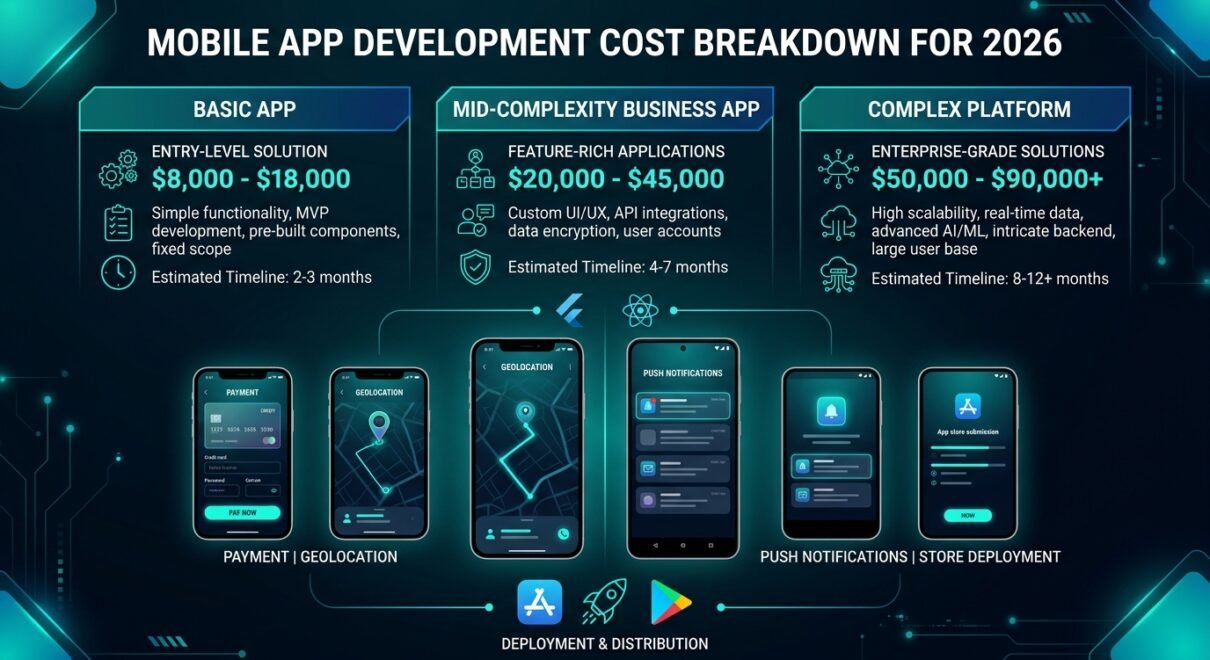
Developing a custom mobile app in 2026 typically costs between $8,000 and $75,000+ when built with a dedicated mobile engineering agency. A basic utility or content application with standard authentication and simple API feeds costs $8,000–$18,000 over 6–8 weeks. A mid-tier business application featuring in-app purchases, real-time push notifications, custom user dashboards, and geolocation runs $20,000–$45,000 over 10–14 weeks. Complex on-demand platforms (e.g., ride-hailing, marketplace logistics, fintech with banking integrations) range from $50,000 to $90,000+ over 16–22 weeks. Developing cross-platform with Flutter or React Native cuts total development costs by 30–40% compared to maintaining two separate native codebases (Swift and Kotlin).
Every founder and enterprise stakeholder asks for an app estimate early, but quotes vary wildly across vendors. One agency quotes $15,000 while another quotes $120,000 for the exact same feature list. In our experience shipping over 25 commercial iOS and Android applications, the price disparity comes down to technical architecture, cross-platform vs. native builds, backend complexity, and geographic labor rates. Below is a line-by-line breakdown of what you actually pay for in 2026.
Mobile app cost tiers by complexity and feature scope
Mobile applications group into three primary architectural complexity tiers:
| App Complexity Tier | Typical Cost (USD) | Typical Timeline | Feature Capabilities Included |
|---|---|---|---|
| Simple / Basic App | $8,000 – $18,000 | 6 to 8 weeks | Email/social login, profile setup, static content feeds, basic REST API integrations, standard UI layout. |
| Mid-Complexity Business App | $20,000 – $45,000 | 10 to 14 weeks | Payment gateway (Stripe/Apple Pay), in-app messaging, real-time push notifications, custom UI animations, admin panel. |
| Complex / Enterprise Platform | $50,000 – $90,000+ | 16 to 22+ weeks | Real-time GPS mapping & driver dispatch, video streaming, end-to-end encryption, multi-tier user permissions, complex custom backend. |
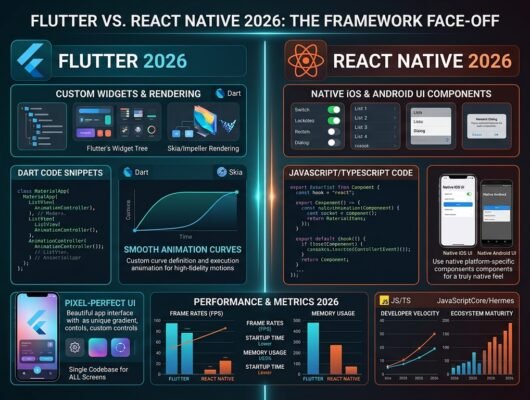
Cross-platform (Flutter / React Native) vs. Native (Swift & Kotlin)
The single biggest architectural decision affecting your development budget is whether to build native or cross-platform:
| Factor | Cross-Platform (Flutter / React Native) | Dual Native (Swift + Kotlin) |
|---|---|---|
| Initial Build Cost | Baseline (100%) | 160% – 180% (Requires 2 separate engineering teams) |
| Codebase Maintenance | Single shared codebase for iOS and Android | Two independent code repositories to update and test |
| Time to Market | 30% – 40% faster release cycles | Slower; features must be coded twice |
| Performance | Indistinguishable from native for 95% of business apps | Maximum performance for 3D games and heavy AR/VR processing |
| Best Recommendation | MVPs, SaaS companions, e-commerce, mobility apps | High-frame-rate games, hardware peripheral utilities, Apple Watch-centric apps |
For over 90% of commercial use cases in 2026, building cross-platform is the sensible engineering choice. It eliminates feature disparity between iOS and Android users while cutting ongoing maintenance costs in half.
Line-item development cost breakdown by component
When budgeting an application build, engineering costs divide into six primary layers:
1. Product discovery, UX architecture, and wireframing ($2,000–$6,000)
Defining user personas, mapping screen-by-screen user flows, and creating interactive low-fidelity wireframes. Skipping this phase is the primary cause of mid-project scope creep.
2. UI design & design system ($3,000–$8,000)
Designing high-fidelity screens in Figma with custom component states, dark mode variants, iconography, and typography compliant with Apple Human Interface Guidelines and Google Material Design 3.
3. Frontend mobile client development ($5,000–$28,000)
Coding the user interface, local state management (Redux, Riverpod, Bloc), smooth screen transitions, offline caching, and responsive tablet/foldable layouts.
4. Backend API, database & cloud infrastructure ($4,000–$22,000)
The server logic powering the app: PostgreSQL database architecture, REST/GraphQL endpoints, authentication security (OAuth, JWT), role-based permissions, and cloud deployment on AWS or Google Cloud.
5. Third-party SDK integrations ($2,000–$8,000)
Integrating third-party services: Stripe or Apple/Google In-App Purchases, push notification providers (OneSignal, Firebase Cloud Messaging), mapping SDKs (Google Maps, Mapbox), and analytics telemetry (Mixpanel, PostHog).
6. Quality assurance, device testing, and store submission ($2,000–$6,000)
Automated and manual testing across 10+ real iOS and Android physical devices (screen sizes, OS versions), network degradation testing, and managing Apple App Store and Google Play Store submission review guidelines.
Hidden ongoing costs after publishing to the App Store
Publishing your app is the beginning of its lifecycle. You should plan for these recurring operational expenses:
- Developer Account Fees: Apple Developer Program ($99/year), Google Play Developer Console ($25 one-time fee).
- Backend Cloud Hosting: $30–$250/month (AWS, Supabase, or DigitalOcean) depending on active user concurrency.
- Third-Party SaaS Subscriptions: $0–$100/month (Push notifications, transactional emails, error monitoring via Sentry).
- Annual OS Compatibility Updates: $2,000–$5,000/year (Updating code to comply with annual major iOS and Android release deprecations).
- Maintenance Retainer: $300–$1,000/month for ongoing bug fixing, dependency patching, and minor feature iterations.
How to reduce app development costs without losing quality
- Start with a focused v1 MVP: Identify the single core workflow that solves your user’s primary problem. Defer non-critical features (social feeds, secondary payment methods, advanced gamification) to version 2.
- Leverage battle-tested third-party SDKs: Do not pay developers to write custom authentication or video players from scratch. Using audited libraries saves 60+ hours of development.
- Hire a dedicated offshore engineering team: Partnering with vetted studios in technology corridors like Pakistan reduces developer rates from $120–$180/hr (US/UK) to $25–$45/hr without sacrificing code quality or architecture standards.
FAQ: Mobile app development costs in 2026
How much does it cost to build a simple mobile app?
A simple mobile app with 8 to 15 screens, basic user accounts, and standard API connectivity costs between $8,000 and $18,000 with a dedicated development team, taking approximately 6 to 8 weeks to deploy.
Why is building an app more expensive than building a website?
Mobile applications must handle offline data states, local hardware sensors (camera, GPS, biometrics), strict background processing limits, push notification delivery pipelines, and compliance with rigorous Apple and Google store review requirements across hundreds of physical device screen sizes.
How much does it cost to build an app like Uber or Airbnb?
A multi-sided on-demand marketplace platform like Uber (which requires a passenger app, driver app, real-time dispatch backend, and admin dashboard) costs between $45,000 and $85,000+ to develop as a production-grade MVP in 2026.
Do I have to pay for iOS and Android separately?
Not if you choose cross-platform frameworks like Flutter or React Native. A single codebase deploys to both the Apple App Store and Google Play Store simultaneously, reducing your total build and maintenance costs by 30% to 40% compared to native iOS and Android development.
Planning an upcoming mobile app project for iOS and Android? Our mobile app engineering team at Satsuma Droid builds high-performance Flutter and React Native applications with guaranteed store approval. Get in touch for a detailed, line-by-line technical estimate of your mobile app concept today.