
Flutter vs React Native in 2026: the concise answer
Choose Flutter if you prioritise consistent UI across platforms, have a team that can work in Dart, or are building a visually complex app where pixel-perfect design matters. Choose React Native if your team already knows JavaScript, you’re integrating heavily with platform-native APIs, or you need tighter access to the Android and iOS ecosystems. Both are production-ready in 2026. Neither is universally better — the right choice depends on your team, your platform requirements, and where most of your users are.
We’ve shipped projects in both frameworks. The comparison below is based on real project outcomes, not benchmarks run in isolation.
Performance: who wins in 2026?
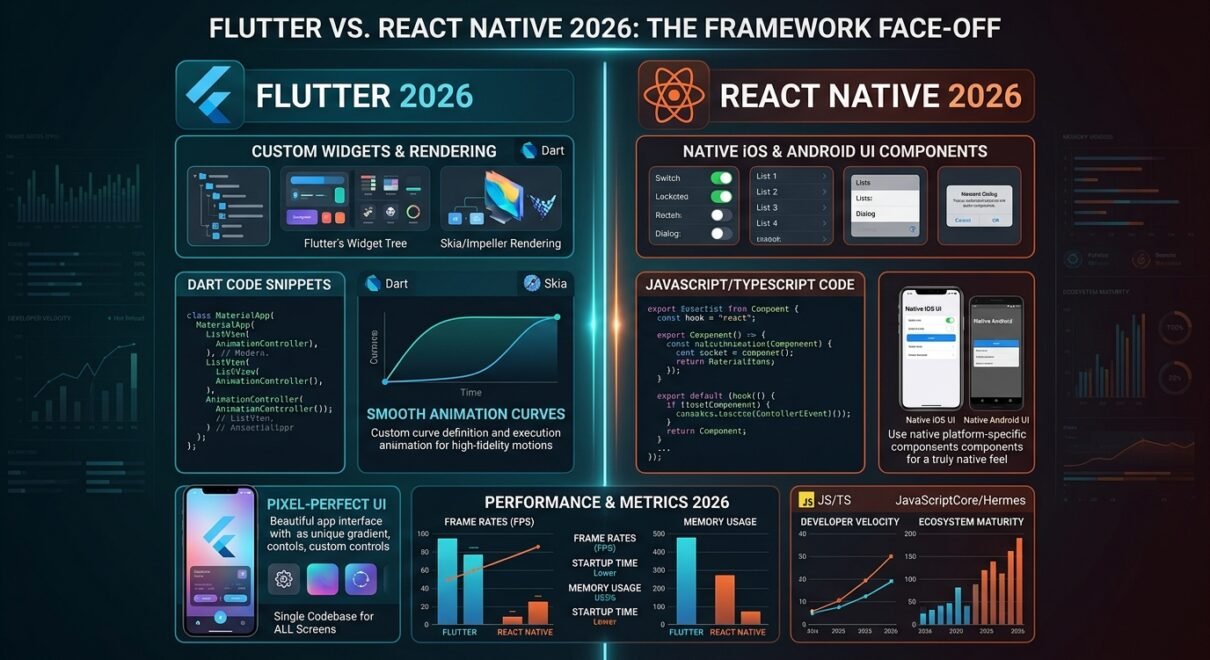
Flutter compiles directly to native ARM code and renders using its own Impeller graphics engine — it doesn’t depend on a JavaScript bridge or native UI components. The result is consistently smooth rendering at 60–120fps with predictable frame times, even in animation-heavy screens. For apps with complex, custom UI — onboarding flows, data visualisations, interactive charts — Flutter’s rendering model has a clear advantage.
React Native in 2026 runs on the New Architecture (Fabric renderer + JSI, the new JavaScript interface), which eliminated the asynchronous JavaScript bridge that caused the jank the framework was criticised for in its early years. In our experience, a well-written React Native app with the New Architecture enabled is indistinguishable from native in most standard use cases: lists, navigation, forms, modals. The gap with Flutter narrows significantly for typical business apps.
Where Flutter still leads: GPU-heavy animations, custom drawing, games, and design systems that deviate significantly from platform conventions. Where React Native closes the gap: standard app patterns (feeds, dashboards, e-commerce flows), where the New Architecture makes the bridge overhead irrelevant.
Developer ecosystem and hiring
This is where the practical decision for most teams is made. React Native uses JavaScript and TypeScript — languages the majority of frontend developers already know. If you have a web development team and want them to ship a mobile app, React Native’s learning curve is measured in weeks. Your existing JavaScript toolchain, testing libraries, and CI/CD setup transfer directly.
Flutter requires Dart. Dart is not difficult — most developers with a typed-language background pick it up within a month — but it is a real barrier. The global pool of experienced Flutter developers is smaller than the React Native / JavaScript pool. When hiring, this matters: Flutter specialists command a 10–20% rate premium in most markets, and finding senior Flutter developers is harder than finding senior React Native developers.
That said, Flutter’s tooling is excellent. Hot reload is fast, the widget library is comprehensive, and the Flutter DevTools debugger is among the best in cross-platform mobile development. Once a team is productive in Flutter, they tend to stay productive — the framework’s opinionated structure reduces the surface area of bad decisions.
Platform coverage and third-party integrations
| Factor | Flutter | React Native |
|---|---|---|
| Platforms supported | iOS, Android, Web, macOS, Windows, Linux | iOS, Android, Web (via React Native Web), macOS (Catalyst, beta) |
| UI components | Custom-rendered widgets (same on all platforms) | Native OS components (platform-specific look) |
| Third-party library ecosystem | pub.dev — growing fast, but smaller than npm | npm — largest package ecosystem in existence |
| Native API access | Good via platform channels; some APIs need custom bridges | Excellent — deep access to platform APIs, well-maintained native modules |
| Code sharing web + mobile | Possible but complex; Flutter Web is not the same as Flutter mobile | Strong with React Native Web + shared business logic with React |
| Desktop | Stable (macOS, Windows, Linux) | Limited / experimental |
One area where React Native’s npm ecosystem makes a real difference: payment SDKs, analytics integrations, and enterprise device management. Stripe, Braze, Mixpanel, and most enterprise software vendors publish React Native SDKs first. Flutter versions often lag by 3–6 months or are maintained by the community rather than the vendor. If your app integrates with a specific third-party service, check its Flutter SDK status before committing to the framework.
Build time and app size
Flutter apps have historically been larger than comparable React Native apps because Flutter bundles the Impeller rendering engine. A minimal Flutter app on Android is ~6–8 MB; a minimal React Native app is ~3–5 MB. In practice, once your actual app code, assets, and libraries are included, the difference narrows to 2–4 MB — meaningful if your users are on slow connections or limited storage, less relevant for most Western or Gulf markets where the baseline device spec is higher.
Build times: Flutter’s build pipeline is fast in development (hot reload in under a second for most changes), but full release builds — especially for iOS — can take 3–8 minutes depending on project size. React Native release builds are similar. Neither framework is meaningfully faster than the other for CI/CD pipeline purposes.
Which projects we’ve built in each — and what we’d change
Across our mobile project work, we’ve shipped Flutter for: a fintech dashboard with complex animated data visualisations, a white-label delivery tracking app requiring identical UI on iOS and Android (the platform-consistent rendering was the selling point), and a B2B field service app for both mobile and desktop (Flutter Desktop). In all three cases, Flutter’s consistent rendering and the team’s control over every pixel were the decisive factor.
We’ve used React Native for: an e-commerce app integrating with three different payment processors (all had React Native SDKs, none had Flutter), a content platform where the team already maintained a React web app and wanted shared business logic, and a B2C social app where the native look-and-feel on each platform — iOS feeling like iOS, Android like Android — mattered to users. React Native’s use of native components handled this without extra work.
One thing we’d change in hindsight: on the e-commerce project, we initially evaluated Flutter but ruled it out after discovering the primary payment SDK had no Flutter support. The React Native SDK integration took half a day. A Flutter implementation would have required building a custom platform channel bridge — a week of work. The third-party SDK check is the first question we ask on any new mobile project now.
The decision framework: which to choose
Run through these in order:
- Does your primary third-party SDK have a Flutter package? Check pub.dev. If no → React Native is lower-risk.
- Does your team already know JavaScript / TypeScript? If yes and the answer to (1) is unclear → React Native.
- Is your UI heavily customised, animated, or pixel-critical? If yes → Flutter’s rendering model is worth the Dart learning curve.
- Do you need desktop (macOS, Windows, Linux) from the same codebase? Flutter is the only mature option here.
- Do you have an existing React web team? React Native lets you share state management, business logic, and testing setup — significant efficiency gain over 12+ months.
If none of the above produces a clear answer, default to React Native. The JavaScript ecosystem, larger hiring pool, and better third-party coverage make it the safer starting point for most product teams in 2026.
FAQ: Flutter vs React Native 2026
Is Flutter faster than React Native in 2026?
For animation-heavy and visually complex interfaces, yes — Flutter’s custom rendering engine produces more consistent frame rates. For standard app patterns (navigation, lists, forms), the gap is negligible with React Native’s New Architecture. Perceived performance for typical business apps is equivalent. Raw benchmark differences exist in lab conditions but rarely manifest in real-world user experience.
Which framework has more job opportunities in 2026?
React Native, because it uses JavaScript and TypeScript — skills already held by the largest developer community. Flutter job listings are growing fast (Google’s backing drives significant enterprise adoption) but the absolute numbers remain lower. Senior Flutter developers are harder to find and command higher rates. For someone learning a framework to maximise job prospects, JavaScript/React Native is the lower-risk path.
Can Flutter and React Native apps be submitted to both App Store and Play Store?
Yes — both frameworks produce genuine iOS and Android builds that are reviewed and approved through the standard submission process. Google Play and the Apple App Store do not penalise or flag apps built with either framework. The review criteria is the app behaviour and content, not the underlying technology.
What companies use Flutter vs React Native in production?
Flutter: Google Pay, BMW app, eBay Motors, Alibaba (Xianyu). React Native: Facebook, Instagram, Shopify, Discord, Walmart. Both frameworks are used at scale by major companies — “production readiness” is not a differentiator between them in 2026.
If you’re deciding between Flutter and React Native for an upcoming project and want a recommendation based on your specific requirements — team, integrations, timeline, and budget — our mobile development team does free technical scoping calls. We’ll tell you which framework fits your situation and why, without steering you toward the one we prefer. Get in touch here.