
The short answer: you can reduce software development costs by 40% to 60% through structural scoping and hiring models
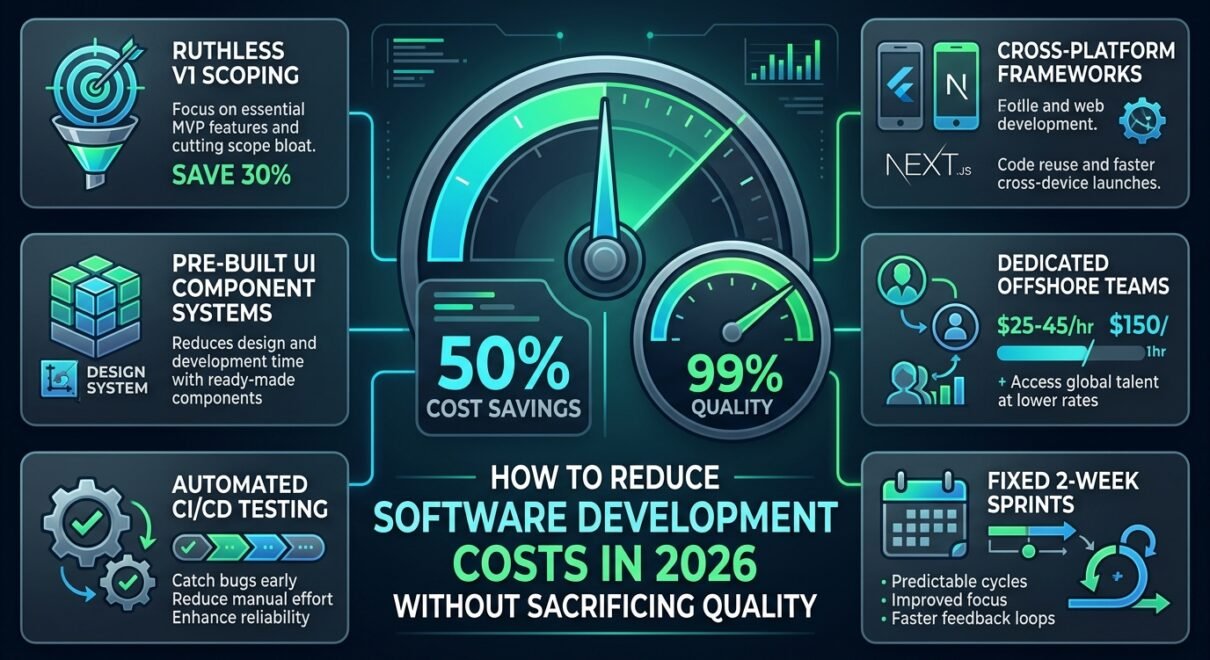
Reducing software development costs without compromising code quality requires four strategic levers: locking a focused version-one feature scope (eliminating 30% of unnecessary code), choosing cross-platform frameworks like Next.js and Flutter, leveraging audited open-source component libraries instead of building standard UI from scratch, and partnering with vetted dedicated engineering studios in offshore hubs like Pakistan ($25–$45/hr vs. $120–$180/hr in the US/UK). Cost reduction should never come from skipping security audits, unit testing, or architectural planning—cutting those areas increases downstream maintenance expenses by 3x to 5x.
Every software project faces budget constraints, but traditional cost-cutting tactics—such as hiring unvetted bargain freelancers on Upwork or skipping automated quality assurance—almost always backfire into broken user flows and expensive rewrites. In our audits across dozens of software builds, over 50% of development waste stems from mid-sprint scope changes, duplicated codebases for iOS and Android, and custom-building commodity features like authentication and billing that already have battle-tested open-source solutions. Below is a practical engineering guide to trimming development expenditures while preserving enterprise-grade reliability.
6 high-impact levers to reduce software development costs
Apply these six engineering and management principles to maximize development efficiency without sacrificing security, performance, or user experience:
| Cost Reduction Lever | Typical Cost Savings | Impact on Quality | Implementation Strategy |
|---|---|---|---|
| 1. Ruthless Version-1 Scoping | 25% – 35% of total budget | Positive (Faster load times, clearer UX) | Build only the single primary workflow that solves the user’s immediate pain point. Defer secondary “nice-to-have” features to a post-launch backlog. |
| 2. Cross-Platform Frameworks | 30% – 40% vs. dual native | Neutral to Positive (Consistent UX) | Deploy Flutter or React Native for mobile, and Next.js for web applications to share business logic, API models, and test suites across platforms. |
| 3. Audited Component Libraries | 40 to 80 developer hours ($1,500–$3,500) | Positive (WCAG accessibility compliance) | Use proven component systems like shadcn/ui and Tailwind CSS rather than writing custom CSS grids, modals, and input fields from scratch. |
| 4. Dedicated Offshore Teams | 50% – 65% in hourly labor rates | Neutral (When vetted for senior engineers) | Hire dedicated product squads in established technology hubs like Pakistan ($25–$45/hr) with direct repository access and daily agile ceremonies. |
| 5. Automated CI/CD & Testing Early | 15% – 20% in post-launch bug fixing | Highly Positive (Prevents regression bugs) | Implement automated GitHub Actions pipelines with Playwright/Jest testing on every pull request, catching defects in development rather than production. |
| 6. Fixed 2-Week Sprint Boundaries | 15% – 25% eliminated scope creep | Positive (Predictable shipping cadence) | Lock sprint requirements for 14-day cycles. Never inject mid-sprint feature requests; place new ideas into the subsequent sprint backlog. |
1. Stop building commodity infrastructure from scratch
In 2026, writing custom user authentication, password reset workflows, payment webhooks, or file upload handlers is an expensive waste of engineering capacity. Mature, audited infrastructure libraries handle these commodity functions out of the box:
- Authentication & User Management: NextAuth, Supabase Auth, or Clerk eliminate 3 to 4 weeks of custom security code, session token handling, and multi-factor authentication (MFA) setup.
- Billing & Invoicing: Stripe Checkout and LemonSqueezy Customer Portals handle global tax compliance, multi-currency conversions, and subscription grace periods with standard SDK integrations.
- Transactional Communications: Utilizing Resend or Postmark with pre-designed email templates saves days of backend mail-server configuration.
By assembling reliable infrastructure primitives, your developers spend 100% of their billable hours building the proprietary core application logic that sets your business apart.
2. Choose cross-platform architecture over dual native development
If your product requires an iOS app, an Android app, and a responsive web dashboard, building three separate codebases (Swift, Kotlin, and React) triples your initial build expense and creates a permanent maintenance tax. In our client builds across e-commerce, mobility platforms, and fintech:
- Flutter / React Native for Mobile: A single engineering team writes one codebase that compiles natively for iOS and Android, sharing UI styling, state management, and business logic.
- Next.js for Web: Server-side rendering (SSR) and static generation on edge networks deliver sub-second page loads without requiring separate frontend and backend hosting clusters.
- Unified REST or GraphQL APIs: Both the web application and mobile clients communicate with the same backend endpoints, ensuring complete data consistency with zero duplicated API development.
3. Optimize your engineering labor structure
Where and how you assemble your development team is the largest variable in your total expenditure. The table below outlines how a standard 12-week MVP build compares across three organizational structures:
| Team Model | Average Hourly Rate | 12-Week MVP Cost | Quality & Operational Risk |
|---|---|---|---|
| US/UK Onshore Agency | $130 – $200 / hr | $80,000 – $140,000 | High quality, but consumes massive startup capital early. |
| Individual Upwork Freelancers | $15 – $40 / hr | $12,000 – $28,000 | High failure rate. No centralized QA, architectural oversight, or accountability. Founder acts as full-time project manager. |
| Vetted Dedicated Studio (Pakistan) | $25 – $45 / hr | $18,000 – $36,000 | Balanced. Senior engineers, tech leads, direct repository ownership, and agile sprint delivery at 60% lower cost. |
One real case study from our software engineering practice: a UK-based e-learning startup was quoted £72,000 (~$94,000 USD) by a local London agency to build a custom interactive course portal. We restructured their technical requirements, adopted Next.js and Tailwind CSS with a PostgreSQL backend, and deployed a dedicated engineering squad of three senior developers for $24,500. The platform launched in 10 weeks, saving over $69,000 in capital that the founders redirected into direct student acquisition campaigns.
4. What you must NEVER cut when reducing development costs
Cost reduction becomes destructive when teams cut corners in fundamental engineering disciplines:
- Never skip architectural planning and database schema design: Changing an unindexed or poorly normalized database schema after launch with 10,000 active users is ten times more expensive than spending 5 days designing it properly up front.
- Never skip automated testing for core revenue paths: Checkout flows, sign-ups, and user authorization must have automated end-to-end test coverage. Catching a payment bug in production costs thousands in lost transactions and customer trust.
- Never skip security audits and dependency scanners: Unpatched open-source libraries leave applications exposed to automated vulnerability bots. Routine dependency scans (e.g. Snyk, npm audit) take minutes and prevent severe data breaches.
- Never skip root repository and cloud ownership: Always maintain primary administrative ownership of your GitHub, AWS, and domain accounts. Never allow a vendor to host your assets in their private accounts.
FAQ: Reducing software development costs in 2026
How much can I realistically save by building an MVP with an offshore team?
Partnering with a vetted dedicated development team in an established tech corridor like Pakistan typically reduces overall development expenditures by 50% to 65% compared to hiring onshore agencies in the US, UK, or Western Europe, with no difference in code architecture or performance.
Does using pre-built UI components make my software look generic?
No. Modern component systems (like Tailwind CSS and shadcn/ui) are headless and fully customizable. They provide the underlying accessibility, keyboard navigation, and responsive logic, while allowing designers to apply your unique brand typography, color palettes, and component styling.
What is the biggest hidden cost driver in software development?
Scope creep is the single largest cost driver. Adding features or changing data flows in the middle of a development sprint disrupts engineering momentum and forces extensive refactoring. Keeping a disciplined backlog with fixed 2-week sprint boundaries prevents budget overruns.
Is it cheaper to use no-code tools like Bubble instead of custom code?
No-code tools are cheaper for simple prototypes ($3,000–$6,000). However, once an application requires complex data calculations, strict data privacy, high API concurrency, or custom mobile distribution, no-code platforms hit performance walls, forcing a complete and costly rebuild in custom code.
Looking to build your web or mobile application within a predictable, transparent budget? Explore our custom web development services and dedicated engineering team models at Satsuma Droid. Schedule a complimentary technical scoping session with our lead architects today.