

Choosing between Flutter and React Native in 2026 comes down to your app’s core functionality. If your MVP requires complex integrations with native device hardware, mature third-party SDK support, or relies on an existing web-based React team, React Native is the superior choice. If your primary goal is delivering a highly custom, graphics-intensive UI that looks absolutely identical across iOS and Android with minimal performance overhead, Flutter is the better framework.
For startup founders and enterprise product managers alike, selecting the right cross-platform framework for a Minimum Viable Product (MVP) is one of the highest-stakes technical decisions you will make. A misstep here results in delayed launches, ballooning budgets, and technical debt that can kill a project before it even reaches the market. In 2026, both Flutter (backed by Google) and React Native (backed by Meta) have matured significantly, but their distinct architectural philosophies mean they are not interchangeable.
The Architectural Divide
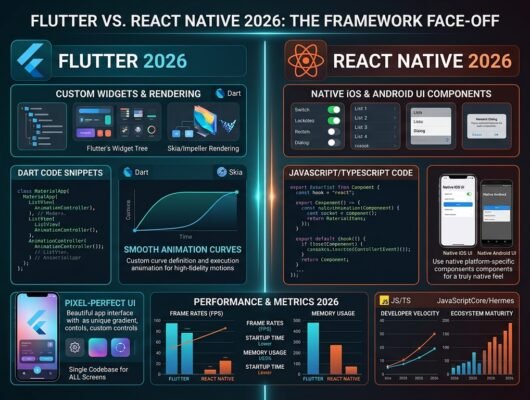
React Native uses a JavaScript bridge to render actual native components, while Flutter uses its own rendering engine (Skia/Impeller) to draw pixels directly to the screen. This fundamental difference dictates where each framework excels.
React Native’s approach means that an iOS button in your app is a genuine, native iOS button. This provides a truly native feel but can introduce slight performance bottlenecks if the JavaScript bridge is heavily loaded. Flutter, conversely, bypasses the platform’s native UI components entirely. It draws every button, text field, and animation itself. This guarantees consistent visuals across all devices and exceptionally smooth animations, but it can occasionally feel slightly “off” to users accustomed to strictly native interactions.
Integration and Third-Party Support
React Native boasts a more mature ecosystem for third-party integrations, which is critical when your MVP relies on external services.
When we audited a struggling MVP last quarter, we found the engineering team had chosen Flutter strictly for its UI rendering speed. However, they hadn’t accounted for the lack of specific third-party SDK support for their niche, regional payment gateway. They were forced to write custom native code wrappers, negating the time-saving benefits of cross-platform development entirely.
Because React Native has been around longer and relies on JavaScript, almost every major service provider (from obscure payment processors to specialized analytics engines) offers a mature React Native SDK. If your MVP is an integration-heavy platform, React Native reduces the friction of connecting these disparate services.
Speed to Market and Delivery Metrics
The fastest path to a testable beta depends entirely on the specific feature set of your application.
Our internal delivery metrics at Satsuma Droid show that React Native projects reach the first testable beta 15% faster when the client requires heavy integration with native device features (like advanced camera controls or Bluetooth peripherals). The abundance of pre-existing React Native libraries for these hardware interactions speeds up development significantly.
However, the metrics flip when evaluating pure, UI-heavy consumer apps. If the MVP requires complex, custom animations, complex charting, or highly branded interfaces that deviate from standard iOS/Android guidelines, Flutter teams deliver those UI components noticeably faster. Flutter’s widget-based architecture and powerful rendering engine make implementing bespoke designs highly efficient.
The Developer Talent Pool
Hiring and scaling your team is easier with React Native due to the ubiquity of JavaScript and React developers.
React Native uses JavaScript and the React paradigm. If your company already has a web development team building your SaaS dashboard in React, those developers can transition to React Native with a relatively short learning curve. This allows you to share engineering resources and potentially even share business logic code between your web and mobile applications.
Flutter requires learning Dart, a language developed by Google. While Dart is easy to learn for developers familiar with Java or C#, it still represents an isolated skill set. You are hiring specifically for Flutter, which can sometimes slow down the recruitment process compared to tapping into the massive global pool of JavaScript developers.
Long-Term Viability and Maintenance
Both frameworks are secure, enterprise-grade choices backed by tech giants, but their upgrade paths differ in complexity.
Maintaining a React Native application can sometimes be challenging due to its heavy reliance on third-party libraries. When a new version of React Native is released, you must often wait for the maintainers of those third-party libraries to update their code before you can safely upgrade your app. This dependency chain can create maintenance headaches.
Flutter offers a more cohesive, “batteries-included” ecosystem. Because Google provides a comprehensive suite of official widgets and tools, you rely less on community-maintained packages. Upgrading a Flutter application is generally a smoother, more predictable process.
Frequently Asked Questions
Which framework has better performance, Flutter or React Native?
In 2026, both frameworks offer near-native performance for standard applications. However, Flutter generally holds an edge in rendering complex, CPU-intensive animations due to its direct-to-canvas rendering engine, avoiding the JavaScript bridge overhead present in React Native.
Can I use existing React Native code on the web?
Yes, using React Native for Web, you can share a significant portion of your codebase between your mobile app and a web application, although platform-specific UI adjustments are usually still required.
Is Flutter suitable for enterprise applications?
Absolutely. Major enterprises, including Alibaba, BMW, and Google itself, use Flutter for massive, mission-critical applications. Its strong typing and robust ecosystem make it highly suitable for enterprise scale.
Will either framework become obsolete soon?
It is highly unlikely. Meta heavily invests in React Native for its core products, and Google positions Flutter as a primary UI toolkit across mobile, web, and desktop. Both have massive, active communities and strong long-term roadmaps.
Still unsure which framework is the right technical fit for your product? Contact Satsuma Droid today to discuss your specific requirements with our engineering team.