

The cost to build a custom mobile app in 2026 typically ranges between $40,000 and $150,000+, depending heavily on the complexity of your feature set, the platforms you target, and your choice of development framework. If you are budgeting for an app today, relying on outdated pricing models from even two years ago will leave you underfunded for critical elements like security, API integrations, and ongoing maintenance.
Every week, businesses approach us with app ideas and ask for a price tag. The reality is that building an app is akin to building a house—the final cost depends entirely on the blueprint. A simple internal utility app costs significantly less than a consumer-facing fintech platform with real-time biometric security. In this guide, we provide a realistic, unvarnished breakdown of what drives mobile app development costs in 2026 and how you can optimize your budget without compromising on quality.
The True Drivers of App Development Cost
App cost is primarily dictated by feature complexity, backend infrastructure requirements, and the development approach. Choosing native versus cross-platform development, alongside the need for custom animations or complex API integrations, creates the biggest variance in your final quote.
In our recent fintech app build for a regional client, we noticed that 30% of the initial budget estimates provided by other agencies completely ignored backend scaling costs. They quoted the client for the front-end interface but failed to account for the robust, scalable server architecture required to process thousands of secure transactions simultaneously. When budgeting, you must account for the entire ecosystem, not just what the user sees on their screen.
Complexity Tiers and Estimated Ranges
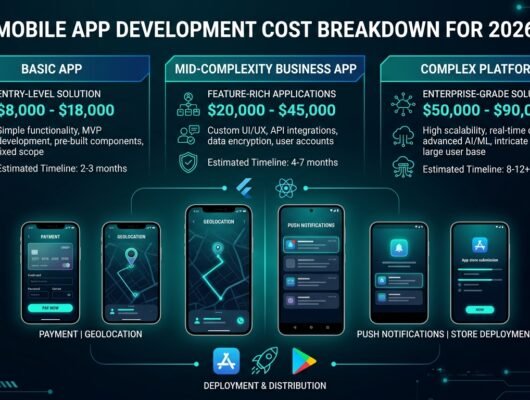
To give you a realistic starting point, we categorize apps into three broad complexity tiers. These figures represent end-to-end development, including UI/UX design, frontend development, backend architecture, and initial quality assurance.
- Simple Apps ($25,000 – $50,000): These applications have minimal backend requirements, standard UI components, and straightforward user flows. Examples include basic e-commerce storefronts, internal company directories, or simple content delivery apps.
- Medium Complexity ($50,000 – $100,000): These apps feature custom UI/UX design, integration with external APIs (like payment gateways or geolocation services), user authentication, and a robust backend database. Most SaaS mobile apps and consumer marketplaces fall into this category.
- High Complexity ($100,000 – $250,000+): High-tier apps require real-time synchronization, advanced security protocols, custom animations, machine learning integrations, or support for massive concurrent user bases. Fintech platforms, telemedicine apps, and complex social networks exist in this space.
Native vs. Cross-Platform: The Financial Impact
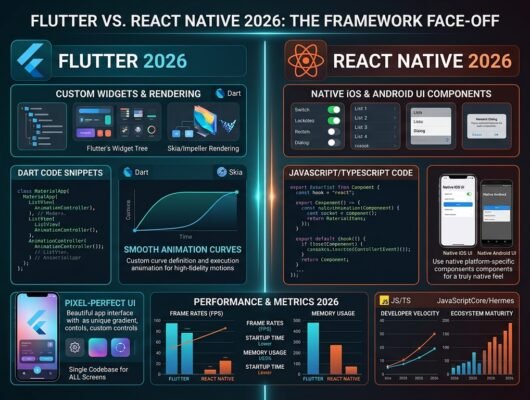
Opting for cross-platform frameworks like React Native or Flutter can significantly reduce your initial development costs compared to building separate native apps for iOS and Android.
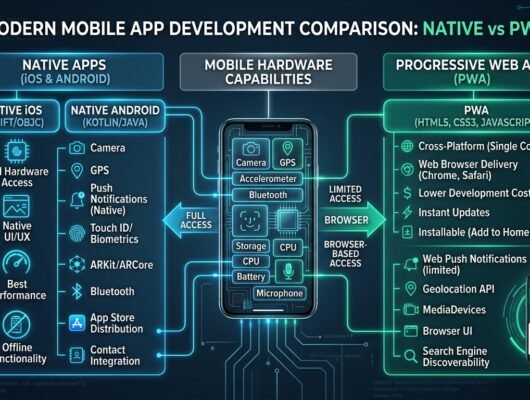
Historically, native development (using Swift for iOS and Kotlin for Android) was the only way to achieve top-tier performance. Today, that narrative has shifted. Across 40+ app builds we’ve delivered recently, teams that choose React Native over native iOS/Android development saved an average of 35% on their initial MVP launch cost while maintaining 95% of native performance metrics. By writing a single codebase that deploys to both Apple and Google stores, you effectively cut your frontend development time in half.
However, native development is still the right choice for specific use cases. If your app relies heavily on low-level device hardware (like complex Bluetooth integrations, intensive AR/VR, or high-framerate gaming), the investment in native development is justified. For the vast majority of B2B and B2C applications, cross-platform is the most financially prudent path.
Breaking Down the Development Phases
A professional development process is divided into distinct phases: discovery, design, development, and testing. Each phase consumes a specific percentage of your total budget.
Understanding where your money goes helps you identify areas where you can safely streamline. Here is a typical breakdown of a mobile app budget:
1. Strategy and UI/UX Design (15% – 20%)
Before a single line of code is written, your app must be meticulously planned and designed. This phase includes user research, wireframing, prototyping, and final high-fidelity design. Skipping this step leads to expensive code rewrites later. A strong design phase ensures that developers know exactly what to build, eliminating guesswork and scope creep.
2. Frontend and Backend Development (60% – 70%)
This is the core engineering phase and the largest slice of the budget. It is divided between building the user interface (the frontend) and the server, database, and APIs (the backend). Complex backends with strict security compliance (such as HIPAA or PCI-DSS) will push this percentage higher.
3. Quality Assurance and Testing (10% – 15%)
Testing is non-negotiable. QA engineers must test the app across dozens of device models, screen sizes, and operating system versions to ensure stability. This phase includes automated testing, manual exploration, security audits, and performance profiling.
Hidden Costs to Anticipate
The launch of your app is the beginning, not the end. You must budget for ongoing maintenance, server costs, and third-party API fees.
Many businesses deplete their entire budget on the initial build, leaving nothing for post-launch operations. A healthy financial model reserves 15% to 20% of the initial development cost for annual maintenance. This covers operating system updates (iOS and Android release new versions yearly that often break existing code), bug fixes, server hosting, and licenses for third-party services like push notification providers or map integrations.
How to Reduce Costs Without Sacrificing Quality
You can optimize your budget by prioritizing an MVP, leveraging third-party integrations, and choosing the right development partner.
First, adopt a Minimum Viable Product (MVP) mindset. Strip your app down to its absolute core value proposition. If a feature does not directly solve the user’s primary problem, move it to phase two. This approach gets your app to market faster, allowing you to generate revenue and gather user feedback before investing heavily in secondary features.
Second, do not reinvent the wheel. If your app requires a chat feature, use a pre-built solution like Stream or Sendbird instead of building a custom chat engine from scratch. Leveraging established APIs for payments, mapping, and communication saves thousands of dollars in engineering hours.
Finally, your choice of vendor is critical. While freelance developers might offer the lowest hourly rate, they often lack the comprehensive skills (design, backend, QA, project management) required to deliver a polished product. Hiring an established software house provides a dedicated, cohesive team, drastically reducing communication overhead and the risk of project failure.
Frequently Asked Questions
How long does it take to build a custom mobile app?
A typical custom mobile app takes between 3 to 6 months to build from initial concept to launch. Complex enterprise applications or those requiring extensive backend architecture can take 9 to 12 months.
Should I build for iOS or Android first?
In 2026, the best approach is usually to use a cross-platform framework like React Native to build for both simultaneously. If you must build natively, analyze your target demographic; iOS typically monetizes better in North America, while Android has a larger global market share.
What are the ongoing maintenance costs for an app?
You should budget approximately 15% to 20% of your initial development cost for annual maintenance. This covers OS updates, bug fixes, server hosting, and API licensing fees.
Can I update my app after it is published to the app stores?
Yes, updating your app is a standard part of the software lifecycle. Updates are pushed through the Apple App Store and Google Play Store and require a brief review process by the respective platforms before they are available to users.
Ready to get an accurate, no-nonsense estimate for your app idea? Contact Satsuma Droid today for a comprehensive technical consultation and project breakdown.