
The short answer: building a SaaS MVP in 2026 costs between $12,000 and $45,000
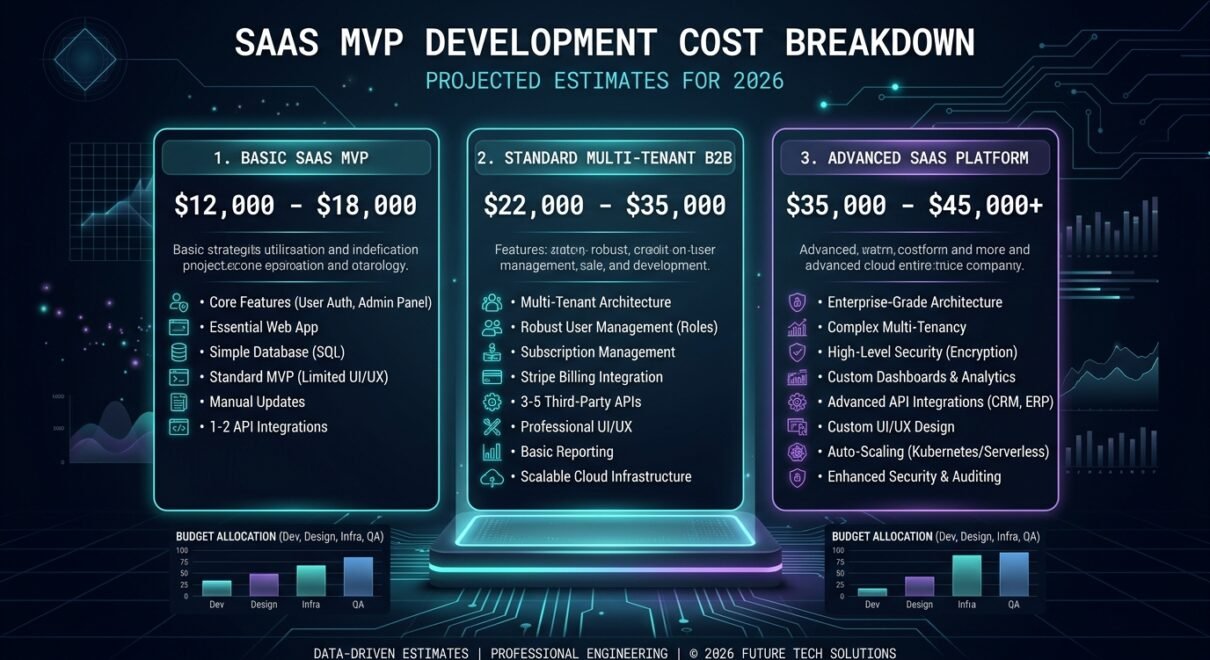
A functional, production-ready SaaS MVP in 2026 typically costs between $12,000 and $45,000 when built with a dedicated development agency or vetted offshore team. A lightweight single-purpose tool with standard authentication and Stripe billing sits at $12,000–$18,000 and takes 6–8 weeks. A multi-tenant B2B SaaS platform with role-based permissions, API integrations, and custom dashboard workflows runs $22,000–$45,000 over 10–16 weeks. Building the same MVP with a US or Western European agency typically exceeds $75,000–$140,000. The breakdown below details every line item based on real production builds.
Every founder wants to know how far their budget goes before writing code. In our experience shipping over 35 web apps and SaaS platforms, budget overruns rarely happen because developers code too slowly. They happen because founders try to build a v2 product on a v1 timeline, or overlook non-functional requirements like billing webhooks, email deliverability, and audit logs. This guide outlines the exact cost components of a SaaS MVP in 2026 so you can budget accurately.
What belongs in a true 2026 SaaS MVP (and what should wait)
An MVP is the smallest version of a product that delivers the core value proposition and validates willingness to pay. In 2026, user expectations for software are higher than five years ago; clunky interfaces and broken mobile views are no longer forgiven. However, building features before validating demand remains the fastest way to deplete capital.
Here is what a modern SaaS MVP must include versus what should be deferred to post-revenue milestones:
| Feature Category | Must-Have in MVP (v1) | Defer to Post-Launch (v2+) |
|---|---|---|
| Authentication & Access | Email/password, Google OAuth, basic RBAC (Admin, Member) | SAML/SSO (Okta), custom permission builders, SCIM provisioning |
| Billing & Subscription | Stripe Checkout / Customer Portal, monthly/annual tiers | Usage-based metered billing engine, custom invoicing workflows |
| Core Value Feature | 1 primary workflow executed smoothly with clear outputs | Multiple secondary tools, marketplace integrations, complex bulk exports |
| Notifications & Comms | Transactional emails (Resend/Postmark), password reset, invites | In-app notification centers, SMS/WhatsApp alerts, complex webhook systems |
| Internal Admin | Basic admin dashboard for user management, subscription status | Full-fledged analytics suite, automated churn prediction, CRM sync |
Detailed cost breakdown by technical component
When budgeting a SaaS build, costs group into six main technical layers. The estimates below assume modern production stacks: Next.js or React frontend, Node.js/Python backend, PostgreSQL database, and cloud infrastructure on AWS or Supabase.
1. Architecture, database design, and setup ($2,000–$4,500)
Setting up multi-tenant database schemas, indexing strategies, API rate limiting, and environment configuration. Getting the schema right at the start prevents costly migrations when your user base grows from 10 to 1,000 organizations.
2. Authentication, multi-tenancy, and user management ($2,500–$5,000)
Modern B2B SaaS requires workspace isolation, team invites, role assignment, and secure session management. Using proven libraries (e.g., NextAuth, Supabase Auth, or Clerk) reduces build time from three weeks of custom security code to roughly 4–6 developer days.
3. Subscription billing and payment integration ($2,000–$4,000)
Connecting Stripe Billing or LemonSqueezy, handling webhook events (successful charge, failed renewal, subscription upgrade, cancellation), and provisioning access rights accordingly. Webhook handling and grace-period logic require careful error handling to prevent billing discrepancies.
4. Core proprietary application logic ($6,000–$20,000)
This is your product’s unique value proposition: the algorithms, data processing pipelines, AI model interactions, custom dashboards, or automation workflows that solve the user’s specific problem. Cost scales directly with complexity and third-party API dependencies.
5. Responsive UI/UX implementation and frontend ($4,000–$9,000)
Building clean, accessible interfaces from Figma wireframes using Tailwind CSS or standard component libraries (shadcn/ui). Includes client-side state management, empty states, error handling, and mobile responsiveness.
6. Quality assurance, automated testing, and CI/CD deployment ($2,000–$4,500)
End-to-end testing with Playwright or Cypress for critical user paths (sign-up, payment, primary feature execution), automated GitHub Actions deployment pipelines, and staging environments.
Development costs by hiring model: 2026 comparison
Where and how you hire directly determines your total spend. Here is how the four primary models compare for a standard 10-week SaaS MVP build:
| Hiring Model | Typical Hourly Rate | Estimated MVP Cost | Key Advantage | Main Risk / Trade-off |
|---|---|---|---|---|
| US/UK Onshore Agency | $120–$220/hr | $75,000–$140,000+ | Same timezone, local legal jurisdiction | Very high cost; depletes startup runway quickly |
| Vetted Offshore Studio (e.g. Pakistan) | $25–$45/hr | $15,000–$32,000 | Full product team, senior leadership, low cost | Requires clear weekly milestone tracking |
| Eastern European Agency | $50–$85/hr | $35,000–$65,000 | Strong engineering talent pool | Higher rates than South Asia with similar stack coverage |
| Individual Freelancers (Upwork) | $20–$60/hr | $10,000–$25,000 | Low direct cost | High coordination overhead; founder acts as project manager |
One real case from our own work: in late 2025, a UK-based logistics startup approached us with a quote from a London agency for £68,000 (~$87,000 USD) for an MVP shipment tracking portal. We audited the technical requirements, reduced unnecessary real-time websocket overhead to efficient polling intervals for v1, and delivered the full production MVP with a dedicated team of four engineers for $21,500 in 9 weeks. The client launched on schedule and used the saved capital to fund their first six months of marketing and sales.
Hidden infrastructure and ongoing costs to plan for
Development is the primary upfront expense, but running a SaaS product involves recurring operational costs from day one. In 2026, modern cloud platforms have generous free tiers, but you should budget $150–$450/month for initial operations:
- Cloud Hosting & Database: $25–$100/mo (Vercel Pro + Supabase Pro or AWS Lightsail/EC2).
- Transactional Email: $0–$20/mo (Resend, Postmark, or AWS SES).
- Authentication & Security: $0–$25/mo (Clerk / Supabase Auth free tiers cover first 10k–50k MAUs).
- Error Monitoring & Analytics: $0–$50/mo (Sentry + PostHog open-source/starter tier).
- Domain & Workspace: $15–$30/mo (Google Workspace + DNS).
- Maintenance & Patching: $200–$500/mo (optional monthly retainer for dependencies and security patches).
How to reduce SaaS MVP costs without cutting quality
To keep your build within budget without sacrificing code quality or security, follow three practical rules:
- Use battle-tested boilerplates and component libraries: Never pay developers to write custom authentication or button components from scratch. Using production-ready open-source foundations saves 40–80 hours of initial development.
- Lock scope for 4-week increments: Changing requirements mid-sprint is the #1 reason projects exceed their budget. Finalize wireframes and data models before starting a sprint, and place new feature ideas into a v2 backlog.
- Pick an established stack: Stacks like Next.js, Node.js, and PostgreSQL have deep documentation, vast developer availability, and proven scalability. Obscure frameworks increase development time and make finding replacement developers difficult.
FAQ: SaaS MVP development costs in 2026
How long does it take to build a SaaS MVP?
A typical SaaS MVP takes between 8 and 14 weeks from initial scoping to production launch. Simple automation tools can launch in 6 weeks, while complex platforms with multi-role permissions and custom integrations require 12 to 16 weeks.
Is it cheaper to build a SaaS with no-code tools?
No-code platforms (such as Bubble or FlutterFlow) can produce initial prototypes for $4,000–$8,000. However, for products that require custom data manipulation, high concurrency, strict data ownership, or complex API integrations, no-code tools often hit technical walls, forcing a complete rebuild in custom code once user volume grows.
What is the minimum budget needed to launch a SaaS MVP?
The minimum realistic budget to design, build, and deploy a secure, custom-coded SaaS MVP with an offshore engineering team is $12,000–$15,000. Trying to build a multi-tenant SaaS application below this threshold usually results in incomplete deliverables or unmaintainable code.
How much does it cost to maintain a SaaS product after launch?
Ongoing maintenance, cloud infrastructure, and security updates typically cost 15% to 20% of the initial development cost annually, or approximately $200–$600 per month for an early-stage SaaS application.
If you’re planning a SaaS product and want an honest, line-by-line cost estimate before investing capital, our custom software engineering team provides free technical architecture reviews. We’ll examine your feature requirements, recommend the most cost-effective stack, and outline a fixed sprint schedule. Get in touch to review your project roadmap.