

Choosing between Next.js and WordPress requires balancing your need for developer control and performance against your need for an accessible, out-of-the-box content management system. WordPress dominates the web due to its immense plugin ecosystem and ease of use for non-technical content creators. Next.js, a modern React framework, offers unparalleled performance, granular control over architecture, and superior scalability for complex applications. The right choice depends on whether you are building a simple marketing site or a highly interactive digital product.
What is WordPress?
WordPress is a monolithic Content Management System (CMS) that powers over 40% of the internet. It couples the database, the backend logic, and the frontend presentation layer into a single, cohesive system.
Because of its monolithic nature, WordPress is incredibly user-friendly for non-technical staff. You can install a theme, add a few plugins, and have a functional website running in a matter of hours. The platform’s true strength lies in its ecosystem; if you need a feature, there is almost certainly a plugin that provides it.
However, this convenience comes at a cost. Heavy reliance on plugins often leads to “bloat,” injecting unnecessary JavaScript and CSS into your pages. This can severely degrade site performance and Core Web Vitals if not meticulously managed. Furthermore, because the frontend and backend are tightly coupled, scaling a massive, high-traffic WordPress site requires complex caching strategies and expensive database optimization.
What is Next.js?
Next.js is a React framework built for production that allows developers to create fast, scalable web applications using Server-Side Rendering (SSR) and Static Site Generation (SSG). Unlike WordPress, Next.js is not a CMS; it is a frontend architecture.
When you build a site with Next.js, you typically adopt a “headless” architecture. This means your frontend (built with Next.js) is entirely separated from your backend data source (which could actually be a headless WordPress instance, Contentful, or Sanity). This decoupling allows developers to optimize the frontend delivery to an extreme degree.
In our web development projects at Satsuma Droid, we have seen remarkable performance shifts when adopting this architecture. Across our last dozen enterprise migrations from monolithic CMS platforms to Next.js, clients experienced an average 65% improvement in Largest Contentful Paint (LCP) times. Because Next.js can pre-render pages at build time (SSG) and serve them globally via a CDN, the Time to First Byte (TTFB) is often near-instantaneous.
Next.js vs WordPress: A Direct Comparison
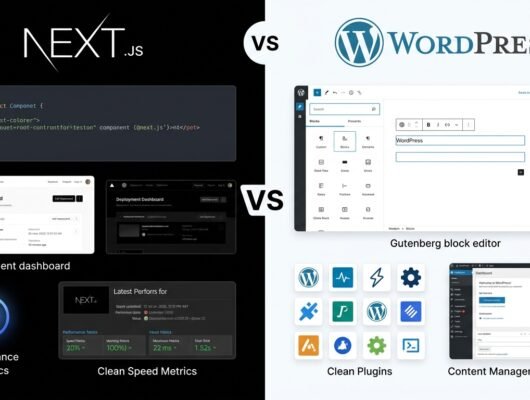
While WordPress excels in rapid deployment and content management, Next.js provides the architectural foundation required for enterprise-grade performance and custom functionality.
| Feature | WordPress | Next.js |
|---|---|---|
| Performance | Variable. Heavily dependent on themes and plugins. Often requires aggressive caching to be fast. | Exceptional. Built-in SSG, SSR, and automatic image optimization guarantee high Core Web Vitals. |
| Content Management | Industry standard. Highly intuitive visual editor for marketing and editorial teams. | Requires integration with a Headless CMS (e.g., Sanity, Strapi) for content editors to manage text/images. |
| Security | Vulnerable to plugin exploits and brute-force attacks if not actively maintained. | Highly secure. Static files and abstracted APIs eliminate the traditional database vulnerabilities. |
| Development Cost | Lower initial cost. Abundant templates and a massive pool of affordable developers. | Higher initial cost. Requires specialized React/Next.js engineers and custom API integration. |
Security is a critical differentiator. Because a standard WordPress site generates pages dynamically by querying a database on every request, it presents a large attack surface. A Next.js site utilizing Static Site Generation serves pre-built HTML files, removing the database layer from the public internet entirely.
Making the Right Choice for Your Business
Your decision should be driven by the complexity of your digital product, your budget, and the technical literacy of the team that will manage the content daily.
- Choose WordPress if: Your primary goal is publishing content quickly (blogs, news sites, standard corporate brochures). You rely heavily on marketing teams who need to build landing pages without developer intervention. Your budget prioritizes rapid time-to-market over micro-optimizations.
- Choose Next.js if: You are building a complex web application, a high-traffic SaaS frontend, or an enterprise e-commerce platform where milliseconds of load time translate directly to revenue. You need strict security compliance and have the budget to retain a dedicated remote team of React developers.
It is also important to note the rising popularity of the “Headless WordPress” approach, which combines both tools. You can retain the familiar WordPress backend for your content creators while using Next.js to deliver the lightning-fast frontend. This offers the best of both worlds, though it does introduce higher architectural complexity.
Frequently Asked Questions
Is Next.js better for SEO than WordPress?
Next.js provides superior technical SEO out-of-the-box due to its exceptional load speeds and Server-Side Rendering capabilities, which search engine crawlers prefer. However, WordPress remains excellent for on-page SEO thanks to established tools like Yoast, making it easier for non-technical users to optimize content.
Can I migrate my existing WordPress site to Next.js?
Yes, by adopting a headless architecture. You keep your existing WordPress installation as the database and content management system, but you rewrite the frontend presentation layer entirely in Next.js, fetching your content via the WordPress REST API or WPGraphQL.
Is Next.js more expensive to host?
Next.js hosting on platforms like Vercel or AWS can be highly cost-effective for static sites, as CDN delivery is cheap. However, if your application relies heavily on complex Server-Side Rendering or extensive API routes, serverless execution costs can scale higher than a traditional shared WordPress host.
Do I need to know React to use Next.js?
Yes. Next.js is a framework built entirely on top of React. To develop, modify, or maintain a Next.js application, your engineering team must have strong proficiency in React and modern JavaScript/TypeScript.
Not sure which architecture is right for your project?
Whether you need a robust Headless CMS architecture with Next.js or a highly optimized WordPress deployment, Satsuma Droid can guide you to the right technological foundation.
Consult With Our Architecture Team