
UI/UX design in 2026 costs between $1,500 and $80,000+ depending on project size
The honest answer: a landing page redesign costs $1,500–$4,000. A full mobile app UX from discovery to handoff runs $8,000–$25,000. An enterprise SaaS product with complex workflows, a design system, and multi-platform coverage costs $30,000–$80,000 or more. The range is wide because “UI/UX design” describes everything from a single screen refresh to months of user research, prototyping, and iterative testing. This guide breaks down what you actually get at each price point — and what the low-cost quotes leave out.
We’ve worked on over 40 product design projects across fintech, e-commerce, health tech, and SaaS. The pricing below reflects what we see in vendor proposals, what clients have paid before coming to us, and what we quote for comparable work today.
What UI/UX design actually includes (most quotes don’t cover all of this)
Before comparing prices, it helps to know what work belongs inside a proper UX engagement. Many low-cost quotes skip the early stages — which is exactly where the expensive mistakes are caught or not caught.
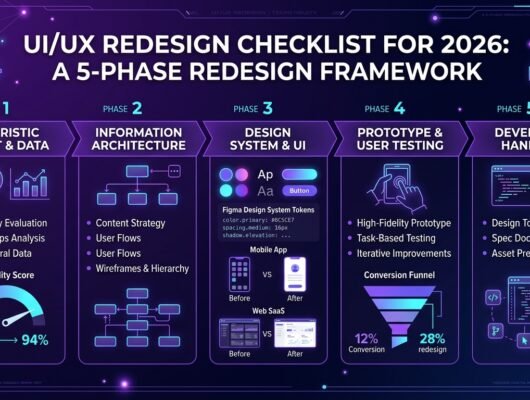
Discovery and research: User interviews, competitor analysis, heuristic review of the existing product (if any). This is the stage where you learn what’s actually broken before designing the fix. Skipping it is how teams build beautiful interfaces that nobody uses. A thorough discovery phase runs 1–2 weeks and adds 15–25% to the total cost — and consistently saves more than it costs by catching wrong assumptions early.
Information architecture (IA): Defining the structure — what screens exist, how they relate, what content lives where, and what the user’s primary paths are. Often delivered as a sitemap or user flow diagram. This comes before any visual design starts.
Wireframes and low-fidelity prototypes: Structural layouts without styling — used to validate flows, identify missing functionality, and test navigation logic before investing in visual design. A good wireframe review catches ~60% of usability problems at a fraction of the cost of catching them in a high-fidelity prototype or after development.
High-fidelity UI design: The visual layer — colours, typography, spacing, component states, interactions. Delivered as Figma files (or equivalent), screen by screen, with annotations for developers.
Interactive prototype: A clickable simulation of the product used for stakeholder sign-off and, in proper engagements, for usability testing with real users before development begins.
Design system / component library: A reusable library of buttons, inputs, cards, navigation patterns, and typography rules — so every screen is consistent and the development team has a single source of truth. Not all projects need a full design system, but any product with more than 20 screens benefits from one.
Developer handoff: Annotated designs, spacing specs, asset exports, and interaction notes packaged for the development team. Without proper handoff, developers guess — and what gets built drifts from what was designed.
Price breakdown by project type
| Project Type | Typical Range (USD) | What’s Included | Timeline |
|---|---|---|---|
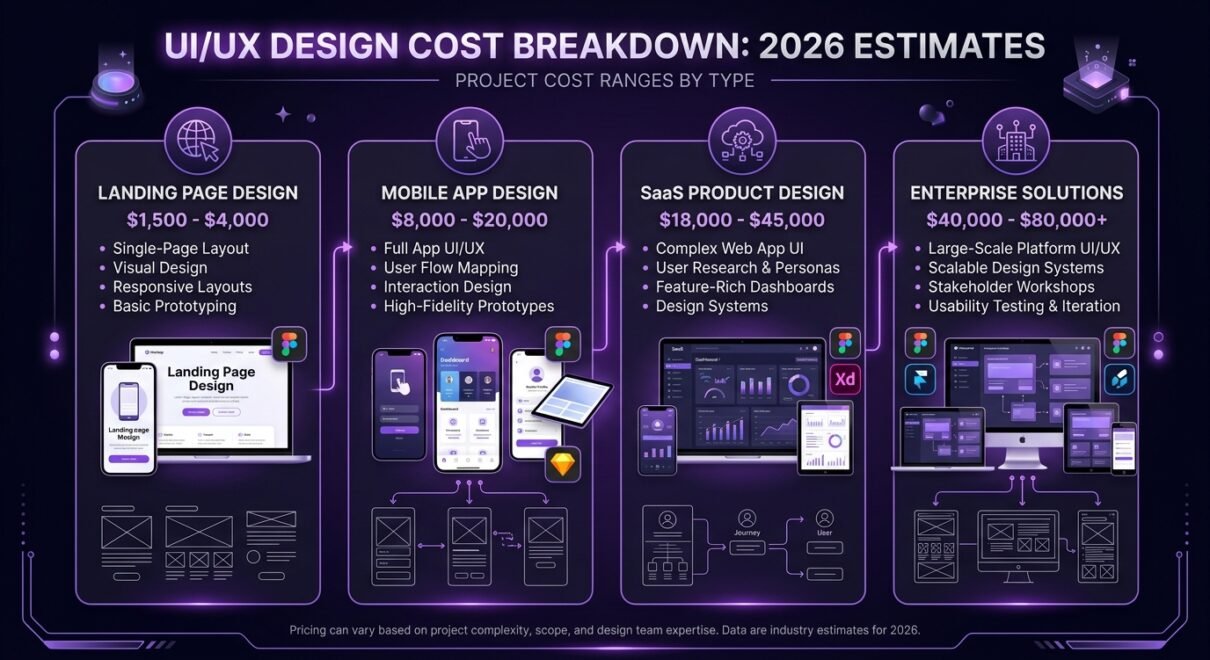
| Landing page / single screen | $1,500–$4,000 | High-fidelity design, 2 revision rounds, handoff | 3–7 days |
| Small web app (8–15 screens) | $4,000–$10,000 | IA, wireframes, UI design, basic component library, handoff | 3–5 weeks |
| Mobile app (MVP, 15–30 screens) | $8,000–$20,000 | Discovery, IA, wireframes, UI design, interactive prototype, handoff | 5–10 weeks |
| SaaS product (30–60 screens) | $18,000–$45,000 | Full discovery, research, IA, wireframes, UI, design system, prototype, usability testing, handoff | 8–16 weeks |
| Enterprise / complex platform | $40,000–$80,000+ | All above + multiple user roles, accessibility compliance, multi-platform, full design system | 12–24 weeks |
Redesign vs new design: Redesigning an existing product is not necessarily cheaper than designing from scratch. Redesigns require a thorough audit of existing patterns, understanding what users currently rely on, and managing the transition carefully so existing users don’t lose functionality they depend on. Budget-wise, redesigns typically cost 70–90% of comparable new product work — not the 30–40% discount many clients expect.
What drives the price up (and what doesn’t)
The biggest cost drivers in UI/UX design are number of unique screens, number of user roles (each role needs its own flows), the depth of user research required, the need for a reusable design system, and whether the design needs to be accessibility-compliant (WCAG 2.2 AA).
What doesn’t meaningfully drive price: the number of revision rounds (within reason — 2–3 rounds per design phase is standard and should be included), whether you want dark mode (add ~15–20% for a complete dark variant), or whether the project is a mobile app vs. a web app of similar complexity.
The price driver that surprises most clients is design-development alignment sessions. When designers and developers don’t communicate directly during the design phase, what gets built diverges from what was designed — and the gap has to be closed somewhere. Either the design changes (revision cost), or the development work is redone (development cost), or the product ships with inconsistencies (user experience cost). Structured collaboration during the design phase costs time upfront and saves significantly in the build phase.
Red flags in a low-cost UI/UX quote
A quote significantly below market — say, $2,000 for a full mobile app — almost always means one or more of these: no discovery or research phase, wireframes skipped (jumping straight to high-fidelity), no usability testing, no interactive prototype, developer handoff is just a PDF export rather than annotated Figma, and no design system (leaving developers to improvise component states). Each of these is a concrete cost-shifter — the work skipped in design gets done, expensively and badly, during development or after launch.
We inherited a fintech app redesign project from another agency whose original quote was $3,500 for “complete UX/UI.” The delivered files had no wireframe stage, no annotated handoff, and 14 of the 28 screens were missing mobile-specific states. The development team had spent six weeks making design decisions that the design engagement was supposed to make. The client paid for a second design engagement to produce the actual developer-ready files — total design spend ended up at $11,000, more than double what proper work would have cost the first time.
FAQ: UI/UX design costs in 2026
Should I pay for UI/UX design separately from development?
Yes — and it is worth doing so even if the same agency is doing both. When design and development are bundled into a single fixed price with no phase separation, design almost always gets compressed to protect development margins. Treating them as separate, sequenced scopes gives you a complete set of approved designs before a line of production code is written — which is the correct order of operations.
What’s the difference between UI design and UX design?
UX (user experience) design covers research, structure, flows, and information architecture — the logic of how the product works. UI (user interface) design covers the visual layer — the appearance of screens. In practice, most product design work involves both, and agencies that separate them into two separate deliverables are usually using terminology to justify scope rather than describing genuinely different work streams.
How many revisions should be included?
Two to three revision rounds per major phase (wireframes, UI design) is standard and should be included in any fixed-price quote without additional charge. Each revision round should have a clear scope — minor changes at the component level — rather than open-ended redesigns. If a quote says “unlimited revisions,” read the contract carefully: “unlimited” usually has a time or cycle limit buried in the terms.
Do I own the design files after the project?
You should — but verify it in the contract. Some agencies retain ownership of design files and license them to clients. The correct arrangement is full ownership of all Figma files, assets, and exported materials on project completion (or as milestones are paid). If the contract says the agency “retains copyright” of any deliverable, negotiate that clause out before signing.
If you’re budgeting a product design project and want a realistic scope estimate before committing to anything, our UI/UX design team offers a free 30-minute scoping call — we’ll tell you what level of engagement your project actually needs and what it’s likely to cost, without a sales pitch attached. Book a call here.