
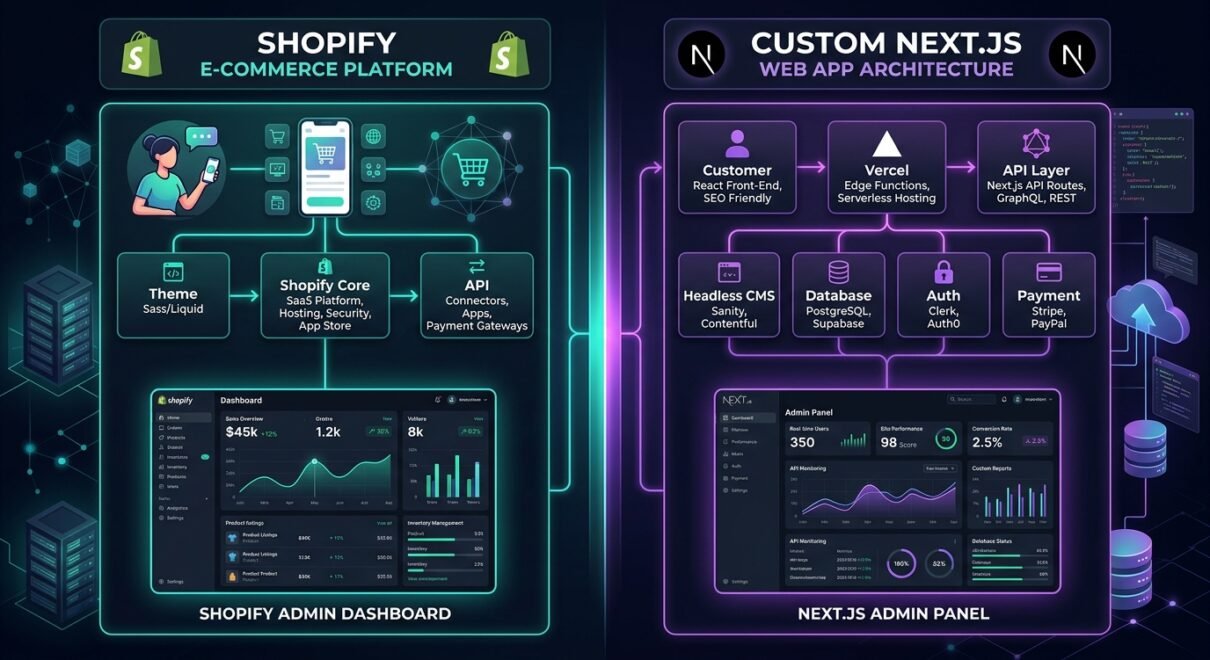
Choosing between Shopify and a custom e-commerce build in 2026 comes down to evaluating your Total Cost of Ownership (TCO) against your requirement for proprietary feature flexibility. While SaaS e-commerce platforms like Shopify have dramatically simplified store launches, high-growth merchants frequently hit technical walls around custom checkout logic, multi-warehouse inventory routing, and compounding monthly app subscription fees. This guide breaks down the financial, technical, and architectural trade-offs of both approaches.
The Revenue Threshold Rule of Thumb
Platform selection should be driven by annual Gross Merchandise Value (GMV) and operational complexity, not tech stack hype.
Across our last 15 e-commerce platform evaluations at Satsuma Droid Pvt Ltd, we observed a clear financial tipping point: early-stage brands processing under $500,000 annually achieved a 40% faster time-to-market on Shopify Plus compared to bespoke web development.
However, once merchants crossed $2.5 million in annual GMV, those relying on heavily customized Shopify setups were spending an average of $3,200/month on third-party app subscriptions alone (subscriptions for subscriptions, subscriptions for batch tracking, ERP syncs, and custom product builders). Transitioning to a headless custom build using Next.js and PostgreSQL saved these brands an average of $38,000 annually in recurring SaaS overhead while improving mobile page speed by 65%.
Side-by-Side Architectural Comparison
Evaluating how both options perform across operational metrics is essential for long-term scalability.
| Evaluation Metric | Shopify / Shopify Plus | Custom E-Commerce Build (Next.js / Headless) |
|---|---|---|
| Initial Launch Cost | Low to Moderate ($5,000 – $25,000 for custom theme setup). | Higher Upfront Investment ($25,000 – $75,000 depending on scope). |
| Ongoing Platform Fees | Monthly subscription ($39–$2,000/mo) + transaction fees (0.5%–2%) + app costs. | Hosting & Database infrastructure costs ($100–$600/mo cloud hosting). Zero transaction surcharges. |
| Custom Functionality | Constrained by Liquid templating and Shopify API limits. Custom checkout requires Shopify Plus. | Unrestricted. Complete control over checkout workflows, B2B pricing tiers, and custom logic. |
| Page Speed & SEO | Good, but weighted down by third-party app scripts and monolithic liquid assets. | Exceptional. Sub-second page loads via serverless React/Next.js and optimized edge caching. |
| Maintenance Responsibility | Managed infrastructure; Shopify handles hosting security, PCI compliance, and uptime. | Requires active software maintenance, security patches, and database backups. |
When Shopify is the Right Choice
Stick with Shopify if standard retail workflows meet 90% of your business needs.
Shopify excels at standard Direct-to-Consumer (D2C) e-commerce. If your business sells physical products with straightforward variants, standard shipping rules, and standard payment gateways, building custom software is an unnecessary expense. Shopify’s app ecosystem, built-in analytics, and automated tax handling allow small teams to focus entirely on marketing and inventory fulfillment rather than software engineering.
When You Need a Custom E-Commerce Build
Invest in a custom e-commerce web application when proprietary workflows form your core competitive advantage.
A custom build becomes mandatory under specific enterprise conditions:
- Complex B2B Quotation & Tiered Pricing: When buyers require custom negotiation, credit terms, volumetric discounts, or multi-organization buyer approvals that Shopify cannot support out of the box.
- Multi-Vendor Marketplaces: Platforms connecting independent sellers, drivers, and buyers with split-payment routing (similar to food delivery or multi-merchant platforms like Wadana Go).
- Proprietary Product Configurators: Real-time 3D or dynamic canvas product builders that lag under standard Shopify theme scripts.
- App Subscription Fatigue: When keeping your store running requires 15+ conflicting third-party plugins that degrade page load speed and introduce security vulnerabilities.
Frequently Asked Questions
Can I use Shopify for my database while building a custom frontend?
Yes, this approach is called Headless Shopify. You use Shopify’s Storefront API to manage inventory and payments while using Next.js or React to build a custom, ultra-fast frontend experience. It provides the speed of custom development with the backend security of Shopify.
How long does it take to build a custom e-commerce web application?
A custom e-commerce web application typically takes between 8 to 16 weeks to design, develop, test, and deploy, depending on the complexity of third-party integrations (ERPs, CRMs, custom payment gateways) and multi-warehouse routing rules.
Are custom e-commerce platforms secure and PCI compliant?
Yes. By utilizing tokenized payment processors like Stripe, PayPal, or Tap Payments, sensitive credit card information is handled directly by PCI-DSS Level 1 certified processors, keeping your custom application compliant without storing raw card data on your servers.
Evaluating an e-commerce platform migration or custom build?
At Satsuma Droid Pvt Ltd, our web architects help enterprise merchants audit their total cost of ownership and build high-performance custom platforms tailored to their business model.
Explore Web Development Services