
The direct answer: start with SEO if you have 6+ months, PPC if you need leads now
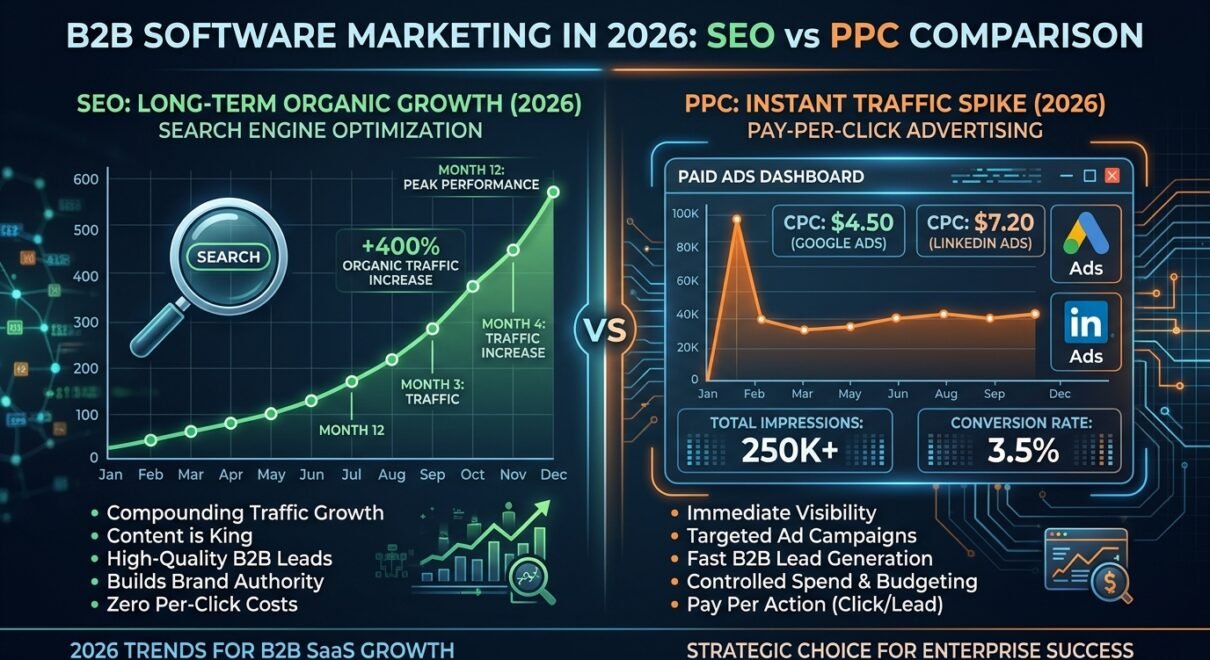
For B2B software companies, the SEO vs PPC decision comes down to one thing: your timeline. SEO compounds over 6–18 months and delivers lower cost-per-lead long-term. PPC gives you traffic in 48 hours but stops the moment you stop paying. In practice, the companies that grow fastest run both — but they sequence them, not run them simultaneously from day one with a split budget that’s too thin to be effective in either channel.
This guide breaks down realistic expectations for each, where each channel wins, what both cost for a software or SaaS company in 2026, and how to decide which to run first given your actual situation.
What SEO actually delivers for B2B software companies — and what it doesn’t
SEO for software companies is not about ranking for “software development company.” That keyword is dominated by Clutch, Upwork, and G2 with millions of backlinks. The winnable SEO plays for a software house are long-tail, intent-rich queries: “cost to build a custom CRM 2026,” “Flutter vs React Native for enterprise,” “dedicated development team vs staff augmentation.” These have lower search volume but much higher purchase intent — and a lower-authority domain can actually rank for them.
What SEO delivers well:
- Compounding traffic: A well-researched article ranking on page 1 sends traffic every month without additional spend. Our best-performing client content pieces now generate 15–25 qualified sessions per day from a single article published 14 months ago — with zero ad spend.
- Trust and authority: A prospect who found you through a search query they typed themselves has higher intent and lower sales resistance than one who saw a banner ad. B2B buyers research extensively; appearing in search signals credibility.
- AI Overview visibility: With Google’s AI Overviews now appearing for 40–50% of informational queries, well-structured content with direct answers, statistics, and clear definitions gets lifted into these panels — which is organic distribution you can’t buy.
What SEO does poorly:
- Speed: A new domain or a domain with low authority will not rank meaningfully for 6–12 months. New content on an established domain can appear in 60–90 days, but competitive terms take longer.
- Predictability: Algorithm updates can move rankings. Google’s March 2026 core update reshuffled rankings significantly for low-quality content sites. SEO is a system, not a faucet.
- Precise targeting: You can’t geo-target or limit SEO to “CFOs in the UK.” PPC can. For very narrow ICP targeting, paid search is more surgical.
What PPC actually delivers — and what it doesn’t
Google Ads and LinkedIn Ads for B2B software companies are effective at one thing nobody else can match: putting your message in front of a specific, defined audience right now. That’s genuinely valuable when you have a product-market fit, a working sales process, and budget to spend while you build organic.
What PPC delivers well:
- Speed: A Google Search campaign targeting “hire dedicated developers Pakistan” can send traffic within 48 hours of launch.
- Precise audience targeting: LinkedIn Ads let you target by company size, job title, industry, and seniority. For enterprise software sales with an ICP of “CTOs at manufacturing companies with 200–2,000 employees,” LinkedIn is the only channel where you can build that exact audience.
- Testing: PPC is excellent for validating messaging, offers, and landing pages before committing to long-form SEO content on the same topic. Run four ad variants for two weeks; the data tells you which value proposition resonates.
What PPC does poorly:
- Cost-per-lead in competitive B2B software niches: Google Ads CPCs for software development keywords run $8–$35 per click in 2026. If your landing page converts at 3%, you’re paying $270–$1,170 per lead before any sales cost. LinkedIn CPCs are higher — $12–$50 — but conversion quality is often better.
- Zero residual value: Pause the campaign, traffic stops. There’s no compounding. Every month you need to re-buy the same eyeballs.
- Ad fatigue on LinkedIn: B2B buyers in software see the same LinkedIn ad formats daily. Frequency caps and creative refresh cycles matter more than they did two years ago.
Realistic cost comparison: SEO vs PPC for a software company in 2026
| Factor | SEO | PPC (Google/LinkedIn) |
|---|---|---|
| Monthly investment | $800–$3,000 (agency/content) | $1,500–$10,000 (ad spend + management) |
| Time to first lead | 3–9 months | 1–2 weeks |
| Average B2B cost-per-lead | $80–$300 (at maturity, 12+ months) | $200–$1,200 (ongoing) |
| Residual value if you stop | Rankings persist (decay slowly) | Zero — traffic stops immediately |
| Best for | 12+ month horizon, authority building | Immediate pipeline, narrow ICP targeting |
| Measurability | Good (GSC, GA4, position tracking) | Excellent (direct click-to-conversion) |
One benchmark from our own digital marketing work: a software client we took on in late 2025 was spending $2,400/month on Google Ads targeting “software development company” — one of the most expensive, most competitive terms in the space. Their cost-per-lead was running at $940. We redirected half that budget into targeted content SEO and restructured the PPC to long-tail, intent-specific terms. Twelve months later, SEO delivers 60% of their inbound leads at roughly $120 per lead; the PPC component at $1,200/month now fills specific service gaps and new-market tests. Total marketing spend dropped 40%; total qualified leads increased.
The decision framework: which to start with
Run through these questions in order:
1. Do you have at least 6 months before you need meaningful inbound revenue from this channel?
If yes → start with SEO. Build the content foundation now so you’re not dependent on paid spend in 18 months.
If no → start with PPC, but begin building your SEO content in parallel at a modest pace so you’re not starting from zero when the ad budget gets tight.
2. Do you have a clearly defined ICP (ideal customer profile) with narrow firmographic characteristics?
If yes, and that ICP is reachable on LinkedIn → LinkedIn Ads deserve serious consideration alongside or instead of Google. LinkedIn’s audience filters are unmatched for precise B2B targeting.
If your ICP is broad (“SME business owners globally”) → Google Search Ads targeting intent-based queries will outperform LinkedIn at lower CPCs.
3. What is your minimum monthly budget?
Below $1,500/month total: put it all in SEO content. A PPC campaign at $800/month in a competitive B2B software niche will generate too little data to optimise and too few leads to justify the management overhead.
$1,500–$5,000/month: split roughly 60/40 SEO/PPC, or 100% SEO if your timeline allows.
$5,000+/month: run both properly, with dedicated budget for each.
4. Do you have a landing page that converts?
PPC traffic only works if the landing page is built for conversion — clear offer, fast load, trust signals, single CTA. Sending PPC traffic to a general homepage is money out of the window. If you don’t have a tested landing page yet, build that before running ads.
FAQ: SEO vs PPC for B2B software companies
Can I run SEO and PPC at the same time?
Yes, and most established software companies do. The two channels are complementary: PPC data (which search queries convert) directly informs which SEO content to prioritise. The risk is splitting a limited budget so thinly that neither channel gets enough investment to work. If your total digital marketing budget is under $2,000/month, sequence them — SEO first — rather than running both at half-strength.
How long does SEO take to generate leads for a software company?
On a domain with some existing authority, well-optimised content targeting long-tail, low-competition queries can appear in search results within 60–90 days. Ranking in the top 5 positions — where meaningful traffic comes from — typically takes 6–12 months for competitive terms. Bottom-funnel content (“cost to build X”, “how to hire Y”) ranks faster than top-funnel educational content because there’s less competition for specific, transactional queries.
Is LinkedIn Ads worth it for a software house?
For software companies targeting enterprise clients, yes — but the minimum viable LinkedIn campaign budget is higher than most people expect. Below $3,000/month in ad spend, LinkedIn’s targeting precision gets wasted on too-small audience samples, and the algorithm doesn’t have enough conversion data to optimise. If you’re targeting SMEs or have a broad audience, Google Search Ads will deliver better ROI at lower spend thresholds.
What’s the biggest mistake software companies make with PPC?
Targeting brand terms and generic category terms (“software development”, “mobile app development”) with no geographic or firmographic qualifier. These terms attract researchers, students, and competitors as much as buyers. The highest-ROI PPC keywords for software companies are specific: “hire Flutter developer Ukraine alternative”, “dedicated development team cost”, “custom CRM development price”. Match intent, not category.
If you’re unsure which channel fits your current stage, our digital marketing team runs a free 30-minute channel audit for software and SaaS companies — we look at your domain authority, existing content, ICP, and budget, then give you a specific recommendation rather than a generic framework. Get in touch to book yours.