

A software maintenance contract is often viewed as an optional insurance policy, but in 2026, it is a fundamental requirement for operational security and performance. As web and mobile applications increasingly rely on complex webs of third-party APIs, open-source libraries, and cloud services, the “set it and forget it” mentality no longer works. This guide breaks down exactly what should be included in a modern software maintenance contract, ensuring you don’t pay for unnecessary overhead while keeping your critical systems online.
The Core Components of a Maintenance Contract
A robust Service Level Agreement (SLA) goes far beyond simple bug fixing; it encompasses proactive security, performance optimization, and infrastructure updates.
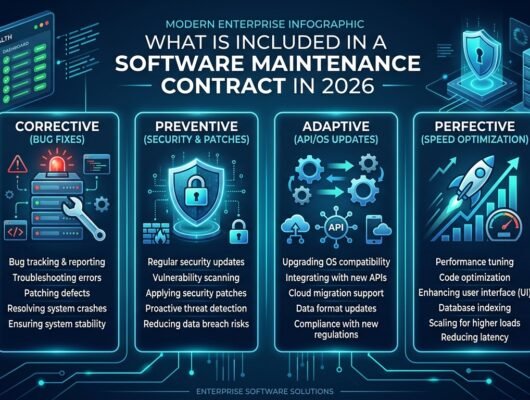
When evaluating a maintenance proposal from a software house, ensure it explicitly covers these four pillars:
- Adaptive Maintenance: Updating the software to keep it compatible with changing environments. This includes upgrading the core framework (e.g., moving from Next.js 14 to 15), updating server operating systems, and ensuring compatibility with the latest iOS/Android releases.
- Perfective Maintenance: Tweaking the existing system to improve performance or user experience based on real-world usage data. This is where slow database queries are optimized and minor UI bottlenecks are smoothed out.
- Corrective Maintenance: Traditional bug fixing. This covers diagnosing and resolving errors that appear after the software has been deployed to production.
- Preventative Maintenance: Proactively auditing the system to prevent future issues, primarily focusing on security patches and vulnerability scanning.
Why Preventative Dependency Patching is Critical
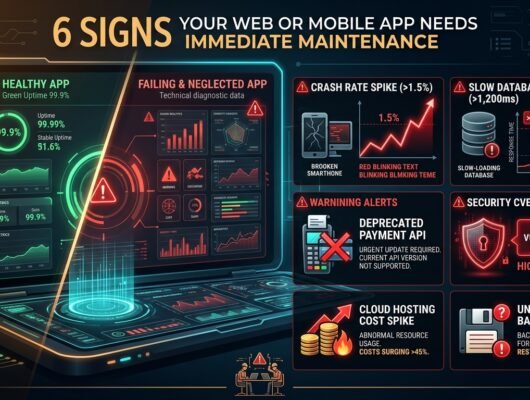
Most modern applications crash not because of bad custom code, but because an unmanaged external library became deprecated or compromised.
In reviewing our maintenance logs over the past year at Satsuma Droid, we found that 68% of critical downtime incidents for mid-sized web applications were caused by unpatched third-party dependencies. Very rarely did the core custom logic fail on its own. A modern maintenance contract must include a monthly audit of all `npm` or `composer` packages. Failing to patch an actively exploited vulnerability in a widely-used open-source library is the fastest route to a data breach.
Realistic Response Times and SLAs
The value of a maintenance contract lies in guaranteed response times when a critical failure occurs.
Your contract must define severity levels and the corresponding Service Level Agreement (SLA) for response and resolution. A standard breakdown looks like this:
| Severity Level | Definition | Target Response Time |
|---|---|---|
| Severity 1 (Critical) | Complete system outage; users cannot log in or process payments. | 1 – 2 Hours |
| Severity 2 (High) | Core feature is broken, but a workaround exists. | 4 – 8 Hours |
| Severity 3 (Medium) | Minor bug affecting a small subset of users; non-critical UI issue. | 24 – 48 Hours |
| Severity 4 (Low) | Cosmetic issue or feature request. | Next scheduled sprint |
Be extremely wary of contracts that promise “immediate resolution” for all bugs. Complex architectural bugs take time to diagnose safely. What you are paying for is an immediate response and the dedication of engineering hours to begin the fix, not a magically instantaneous solution.
What is Typically Excluded?
Maintenance is about keeping the current house standing; it is not about building an extension.
A common point of friction between agencies and clients is the definition of a “bug” versus a “new feature.” If a feature works exactly as it was defined in the original scope, but the client decides they want it to behave differently based on user feedback, that is a new feature request. Standard maintenance contracts do not cover new feature development, major UI redesigns, or migrating the application to an entirely new tech stack. Those require a separate development retainer or a distinct project scope.
Frequently Asked Questions
How much should a software maintenance contract cost?
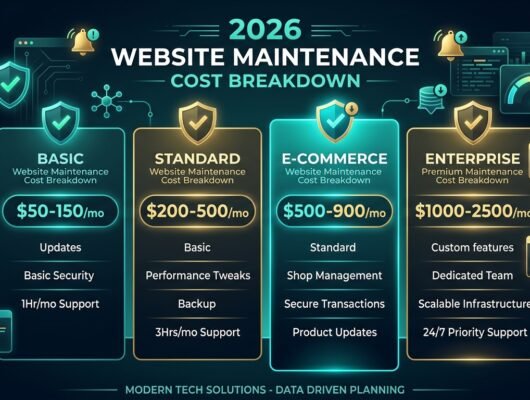
Industry standard dictates that annual maintenance costs should range between 15% to 20% of the initial development cost. For a custom application that cost $50,000 to build, expect to pay roughly $7,500 to $10,000 annually for dedicated maintenance.
Do I need a maintenance contract if my app is built on a modern framework?
Yes. Modern frameworks actually require more frequent maintenance because they evolve rapidly. React, Next.js, and Flutter release major updates annually. Without ongoing maintenance, your application will quickly become incompatible with new mobile operating systems and browser security standards.
What happens to unused maintenance hours?
This depends entirely on the agency. Some contracts operate on a “use it or lose it” monthly retainer model to guarantee engineer availability. Other agencies allow unused hours to roll over for one month, or permit clients to allocate those hours toward small feature enhancements if no bugs occur.
Protect your investment with reliable engineering support.
Satsuma Droid offers comprehensive, SLA-backed maintenance contracts to keep your web and mobile applications secure, fast, and scalable.
View Maintenance Services