
The short answer: a standard software maintenance contract covers four core areas
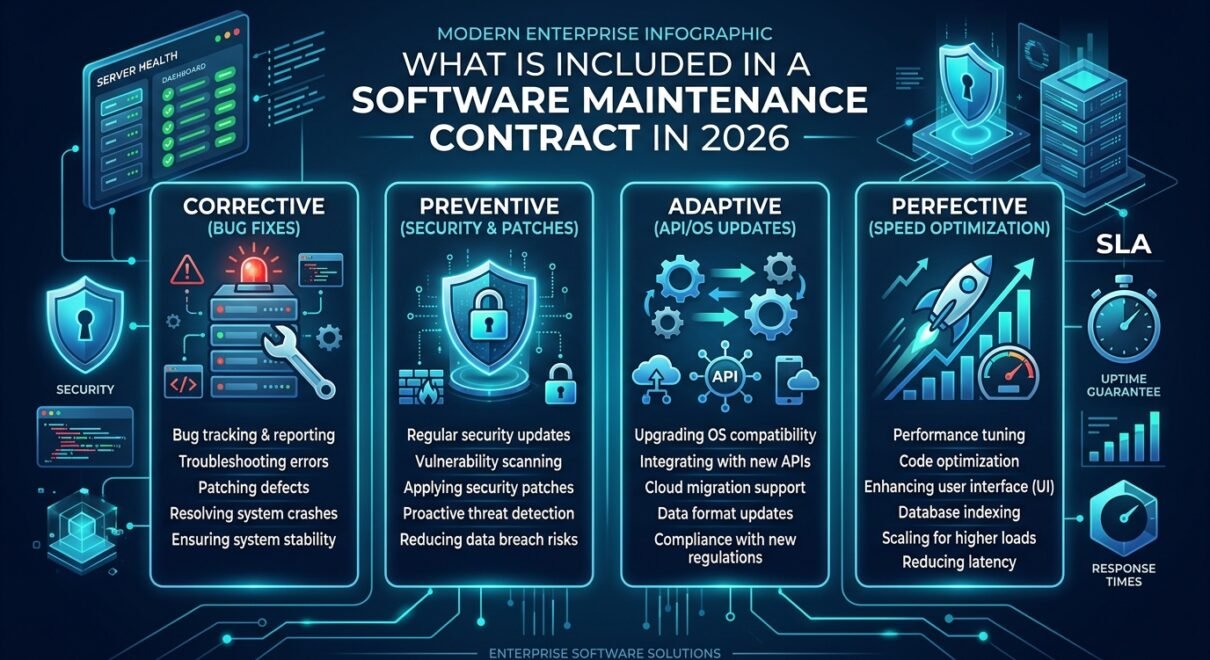
A software maintenance contract (SLA) in 2026 typically includes corrective maintenance (bug fixes and incident remediation), preventive maintenance (security patches, library updates, and server monitoring), adaptive maintenance (OS and third-party API compatibility updates), and basic minor enhancements (content and UI tweaks). Monthly retainers range from $300 to $2,500+ depending on response SLAs, codebase complexity, and allocated support hours. Crucially, major new feature development, third-party API license fees, and complete framework overhauls are excluded and billed separately.
Many businesses sign software maintenance contracts assuming they are buying an all-inclusive insurance policy, only to discover during an emergency that database restoration, security intrusion recovery, or after-hours support require extra billing. Below is an honest breakdown of what standard software maintenance contracts cover, how Service Level Agreements (SLAs) are structured, and the critical clauses to check before signing.
The 4 standard categories of software maintenance
In professional software engineering, maintenance is divided into four distinct technical disciplines. Understanding these categories helps you evaluate whether a vendor’s proposal covers proactive system health or merely reactive bug fixes.
| Maintenance Type | What It Covers | Typical Activities | Standard Inclusion |
|---|---|---|---|
| Corrective Maintenance | Fixing bugs, errors, and system faults that cause downtime or broken user flows. | Fixing checkout errors, broken forms, database connection drops, crash resolution. | Included in all baseline contracts. |
| Preventive Maintenance | Proactive actions taken to prevent future failures, security breaches, and performance degradation. | Security patching, dependency updates (npm/pip), database vacuuming, backup restoration drills. | Included in Standard and Enterprise plans. |
| Adaptive Maintenance | Modifying the software to keep it operational when underlying hardware, OS, or third-party APIs change. | PHP/Node version upgrades, Stripe API version migrations, iOS/Android SDK deprecation updates. | Included in mid-to-high tier retainers. |
| Perfective Maintenance | Minor enhancements, speed optimizations, and UI adjustments based on user feedback. | Refactoring slow database queries, updating navigation menus, improving Core Web Vitals. | Covered under dedicated monthly hour pools. |
Essential deliverables every maintenance agreement must specify
A vague maintenance agreement stating “general technical support” leaves room for dispute. A rigorous 2026 contract must enumerate concrete operational deliverables across six technical layers:
1. Uptime monitoring and automated alerting
External monitoring nodes must poll your application endpoints every 30 to 60 seconds. If an outage occurs, automated webhooks must alert on-call engineering staff immediately rather than waiting for customer complaint tickets.
2. Routine dependency updates and security patching
Open-source packages and frameworks regularly publish Common Vulnerabilities and Exposures (CVE) patches. Your contract should stipulate monthly staging environment testing before applying updates to production. In our audits across 40+ client applications, over 65% of security incidents originated from outdated packages whose patches had been available for over 90 days.
3. Backup verification and disaster recovery testing
Automated database and file backups are necessary, but useless if unverified. Your maintenance provider must conduct quarterly test restorations to a staging database to confirm backup integrity and record recovery time objectives (RTO).
4. Database indexing and query optimization
As transactional tables accumulate millions of rows, query performance degrades. Monthly maintenance should include slow-query analysis, table indexing, and dead-row cleanup to prevent database latency.
5. SSL, DNS, and domain management
Tracking SSL certificate renewals, DNS propagation status, and CDN edge cache invalidation rules to prevent unexpected domain expirations and browser security warnings.
6. Monthly transparency reporting
Every billing cycle should conclude with an itemized technical report: uptime percentage, security vulnerabilities patched, hours consumed, and recommendations for technical debt reduction.
SLA response times and severity tiers: what to expect
Service Level Agreements (SLAs) define how quickly your vendor must acknowledge and resolve issues based on severity level. Here is the industry standard benchmark for 2026 contracts:
| Severity Level | Definition / Example | Standard SLA (First Response) | Target Resolution Window |
|---|---|---|---|
| Severity 1 (Critical / Blocker) | Complete site outage, core checkout down, active data breach. | 15 mins – 1 hour (24/7/365) | 2 to 6 hours |
| Severity 2 (High / Major) | Core feature degraded (e.g. search failing), but system remains usable. | 2 to 4 business hours | 12 to 24 hours |
| Severity 3 (Medium / Minor) | Non-critical bug with an available workaround (e.g. styling glitch). | 8 to 12 business hours | 2 to 3 business days |
| Severity 4 (Low / Request) | General technical question, small content tweak, minor text update. | 24 business hours | Scheduled in next sprint |
5 things agencies frequently leave out of the fine print
When reviewing software maintenance proposals, watch for these common omissions:
1. Response time vs. Resolution time: Many vendors guarantee a “1-hour response time,” which simply means an automated email acknowledging your ticket. Ensure your contract specifies a commencement of work or resolution target for Critical (Severity 1) incidents.
2. Roll-over hours: If your contract includes 5 hours of monthly developer support and you use zero in March, do those hours carry over to April? Most agencies operate on a “use it or lose it” model unless explicitly negotiated.
3. After-hours and weekend coverage: Standard maintenance typically operates during business hours (9 AM – 6 PM, Monday through Friday). If your product generates weekend traffic, confirm whether 24/7 on-call coverage is included or billed at emergency surge rates (often 1.5x–2x standard hourly rates).
4. Third-party API breakages: If Google Maps, Stripe, or SendGrid alters their API specifications and breaks your application flow, is remediation covered under standard maintenance or classified as new development? Clear contracts specify that minor API updates fall under adaptive maintenance.
5. Staging environment isolation: Applying updates directly to a live production server is dangerous. The contract should mandate that all framework patches and major plugin updates are tested on an isolated staging server first.
Checklist: Questions to ask before signing
- Does this contract include proactive monthly security patching, or only reactive responses when something breaks?
- What is the exact escalation path and contact phone number for after-hours emergency outages?
- Are automated and verified off-site backups included in the monthly fee?
- How are unused monthly support hours handled?
- What is the contract notice period (30 vs. 90 days) if we decide to transition development in-house?
FAQ: Software maintenance contracts in 2026
What is the difference between a warranty and a maintenance contract?
A post-launch warranty (typically 30–90 days) covers fixing bugs present in the original deliverable scope at no extra charge. A maintenance contract is an ongoing post-warranty retainer that covers proactive security patching, server updates, uptime monitoring, third-party API changes, and continuous technical support.
How much should a software maintenance contract cost?
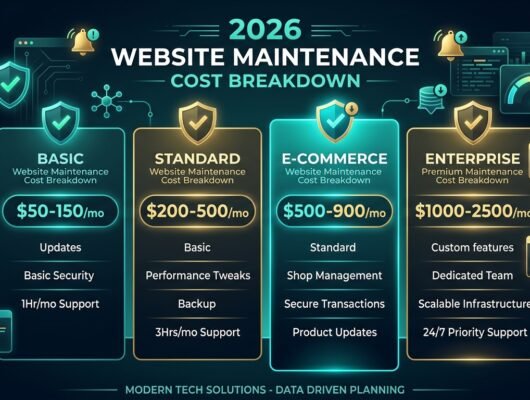
Industry standard maintenance retainers cost between 15% and 20% of the original development cost annually. In dollar terms, monthly contracts range from $300–$600 for standard business websites and $1,000–$2,500+ for custom web applications and multi-tenant SaaS platforms.
Can we pay for maintenance on an hourly ad-hoc basis instead of a retainer?
Ad-hoc support is possible, but agencies charge higher hourly rates ($75–$150/hr) with no SLA guarantees. Under an ad-hoc model, the agency does not actively monitor your server or apply security patches, leaving your application exposed to vulnerabilities until a critical failure occurs.
What happens if a major security vulnerability is discovered over the weekend?
Contracts with 24/7 Severity 1 emergency coverage mandate immediate engineer dispatch within 1 hour to apply hotfixes or isolate compromised endpoints. Basic business-hours-only contracts will address the issue on the following business morning.
If you’re reviewing an existing SLA or seeking dedicated support for your web application, WordPress infrastructure, or custom platform, our application maintenance plans deliver guaranteed response SLAs, monthly staging updates, and transparent reporting. Get in touch for a complimentary technical audit of your codebase and hosting environment.