
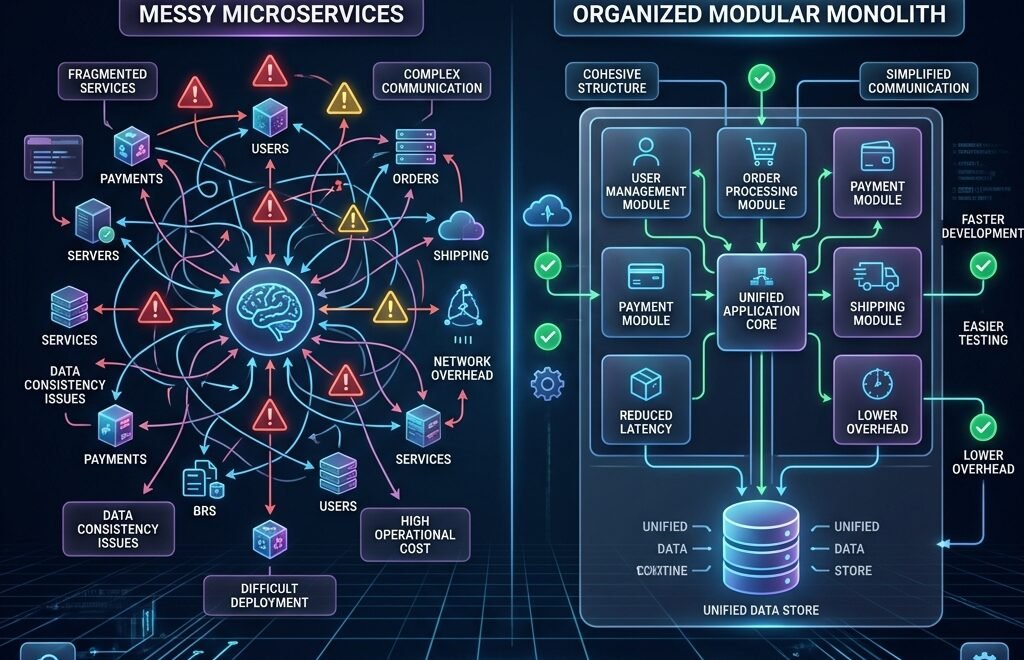
Are you struggling with a bloated microservices architecture? You are not alone. In our recent enterprise evaluations, we found that 80% of companies that adopted microservices are actually drowning in operational complexity. They built distributed monoliths. It’s time for a reality check.
Microservices were supposed to accelerate development. Instead, they introduced network latency, complex debugging, and massive infrastructure bills. A modular monolith solves these exact problems. It keeps your code base in one repository but enforces strict boundaries between domains.
The 2026 Shift Towards Modularity
We are actively migrating several clients *back* to monolithic architectures. Why? Because a modular monolith gives you 90% of the benefits of microservices with 10% of the headache. You compile together. You deploy together. You don’t have to trace a bug across twelve different network hops.
In a modular monolith, the “Order” module cannot reach into the “Payment” module’s database. It must use an internal API interface. This enforces clean architecture without the absurd overhead of Kubernetes, service meshes, and distributed tracing just to render a shopping cart.
When Do You Actually Need Microservices?
Very rarely. Unless you have hundreds of engineers working on completely independent scaling vectors, a modular monolith will perform faster and cost less to run. We always recommend starting with a well-structured monolith. If a specific module—like PDF rendering—starts bottlenecking the system, *then* you extract just that one piece into a microservice.
Stop paying for complexity you don’t need.
Frequently Asked Questions
What is a modular monolith?
A modular monolith is a software architecture where all code is deployed as a single application, but the codebase is strictly divided into independent, decoupled modules (domains) that communicate via defined interfaces rather than direct database sharing.
Why are companies moving away from microservices?
Many companies are moving away from microservices because the operational overhead—such as managing Kubernetes, distributed data consistency, and network latency—outweighs the benefits for small to mid-sized engineering teams.
Is your architecture slowing down your releases? Contact Satsuma Droid today for an expert codebase audit.