

Are your on-premise servers holding you back? They are. In our migration assessments this quarter, we found that 60% of legacy applications are not ready for the cloud. Simply “lifting and shifting” is a massive mistake. You will pay for it later in runaway cloud costs.
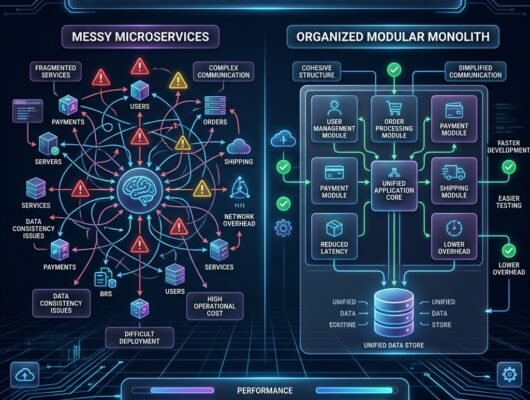
We approach cloud migration differently. We audit the architecture first. A monolithic app dumped onto AWS EC2 instances is just a more expensive monolith. We identify which services can be decoupled, containerized, or replaced with serverless functions.
The 3-Step Audit Process
First, we catalog dependencies. We look for hardcoded IP addresses, local file system dependencies, and outdated libraries. These will break in a distributed cloud environment. We use automated static analysis tools to map these out.
Second, we assess database readiness. Moving a heavy relational database to the cloud without optimizing queries will destroy your budget. We analyze throughput, read/write ratios, and recommend managed services like Amazon RDS or Aurora.
Security and Compliance Mapping
Finally, we map your compliance requirements. A cloud environment is shared. You need proper IAM roles, VPC configurations, and encryption at rest. We ensure that your architecture meets SOC2 or HIPAA standards before a single line of code moves.
A successful migration requires meticulous planning.
Frequently Asked Questions
What is the difference between lift-and-shift and cloud-native migration?
Lift-and-shift simply moves your existing application as-is to cloud servers. Cloud-native migration involves rewriting or refactoring parts of the app to use microservices, containers, and serverless architectures for better scalability.
How do we estimate cloud migration costs?
We start with a comprehensive architecture audit, estimating the compute, storage, and networking resources needed. We then compare pricing models across AWS, Azure, and Google Cloud, factoring in the engineering effort to decouple legacy services.
Don’t lift and shift a broken system. Contact Satsuma Droid today for a cloud readiness audit.